Phone Charging Stations for Events: What 14 Festivals Charge
A one-day unlimited phone charging pass costs $25 at 10 of 14 US festivals. How that compares with lockers, Disney's FuelRod and Universal's $3 swaps.

Data journalist covering markets, platforms, and the economics of rating systems.
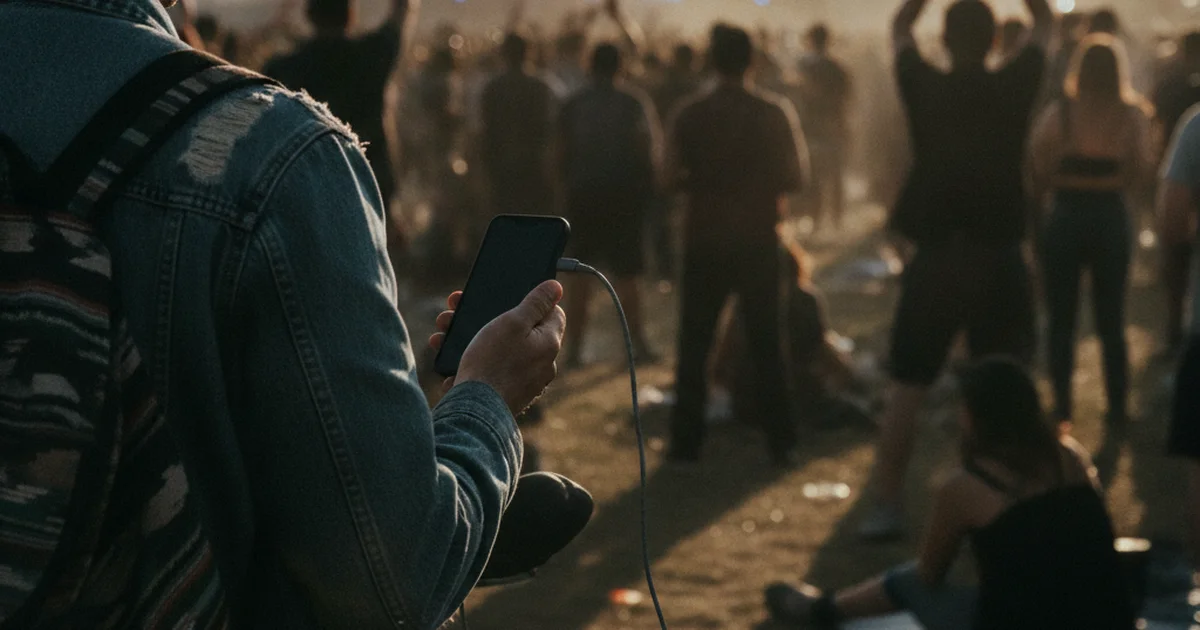
Ask anyone who has spent a Saturday at a rock festival what ran out first, and the answer is rarely water or money. It is the phone. The ticket is on it, the wallet is on it, the set times and the map are on it, and so is the only way to find friends after the headliner. Pew Research Center's Mobile Fact Sheet puts smartphone ownership at 91% of US adults, which means almost every person through the gate is carrying a device that will not last a 12-hour day of video, GPS and weak signal.
That has turned phone charging at events into a small, priced industry with three distinct business models: the swap-pass rental, the charging locker, and the theme-park battery kit. Each one prices the same problem differently. Stanford Tech Review collected the published prices to see what a dead battery actually costs at a festival or a theme park in 2026, and which model is cheapest for which kind of visitor.
The festival model: a pass, not a charger
At large US rock and country festivals, the dominant format is a rental pass sold alongside the festival ticket. The visitor picks up a power bank with built-in cables at a booth, and swaps it for a full one as often as they like until the pass expires.
The most visible operator of this model is ChargerGoGo, a Las Vegas company that runs phone charging for events and festivals including Louder Than Life in Louisville. Its rental page for that festival describes the product plainly: a portable battery with three built-in cables, rented at on-site booths, with "unlimited exchange within the duration of your pass."
The scale of a single customer explains why a festival would outsource this rather than run outlets of its own. Danny Wimmer Presents, which produces Louder Than Life, said in its 2025 wrap-up release that Louder Than Life and Bourbon & Beyond drew a combined, record attendance of more than 450,000 across eight days at the Kentucky Exposition Center. No wall of USB ports serves that many people. A fleet of swappable batteries, which leave the booth and come back, can.
The same release lists the promoter's 2025 festival slate: Aftershock, Bourbon & Beyond, Inkcarceration, Louder Than Life, Sonic Temple and Welcome To Rockville. Each of the six has its own rental page on ChargerGoGo's site, and Ahrefs' backlink index records a link from each festival's official passes page to its ChargerGoGo page, first seen between 2019 and 2022. In other words, the charging pass is sold at the point where the fan buys the ticket, not as an afterthought at the gate.
What 14 festivals charge
ChargerGoGo publishes a price list for each festival it serves. We read all 14 festival pages in its sitemap that list prices (a fifteenth, Barefoot Country Music Festival, lists no items) on November 16, 2026. Where a page shows both an on-site price and a lower advance price, the table uses the on-site price and notes the advance discount.
| Festival | One-day pass | Longest pass | Longest pass price | Cost per day, longest pass | Advance price lower? |
|---|---|---|---|---|---|
| Aftershock | $25 | 4 days | $80 | $20.00 | No |
| Bourbon & Beyond | $25 | 4 days | $80 | $20.00 | No |
| Carolina Country Music Fest | $20 | 4 days | $50 | $12.50 | No on-site price listed |
| Inkcarceration | $30 | 3 days | $65 | $21.67 | No |
| Louder Than Life | $25 | 4 days | $85 | $21.25 | No |
| Ragnar Trail Rainier | $15 | 3 days | $25 | $8.33 | No |
| Rock the Country, Ashland | $25 | 2 days | $45 | $22.50 | Yes, $5 off |
| Rock the Country, Sioux Falls | $25 | 2 days | $45 | $22.50 | Yes, $5 off |
| Rock the South | $25 | 3 days | $65 | $21.67 | Yes, $5 off |
| Sonic Temple | $25 | 4 days | $80 | $20.00 | Yes, $5 to $10 off |
| The Ramble | $20 | 3 days | $55 | $18.33 | Yes, $5 off multi-day |
| Voices of America | $25 | 4 days | $60 | $15.00 | No on-site price listed |
| We Fest | $25 | 3 days | $65 | $21.67 | Yes, $5 off |
| Welcome to Rockville | $25 | 4 days | $80 | $20.00 | No |
Source: ChargerGoGo festival rental pages, checked November 16, 2026. Some pages carry a prior season's slug, so prices reflect what is listed, not a confirmed 2026 rate card.

Chart: Stanford Tech Review analysis of ChargerGoGo festival rental pages, checked November 16, 2026. Per-day cost is the longest pass price divided by its number of days.
The pattern is a de facto standard price. A one-day unlimited phone charging pass costs $25 at 10 of the 14 festivals, and at the seven four-day festivals the median full-run pass is $80, or $20 a day. The outliers sit at either end for visible reasons: Inkcarceration charges $30 for a day, while Ragnar Trail Rainier, a trail relay rather than a concert, charges $15 for one day and $25 for three.
Two smaller findings matter for anyone budgeting a trip. First, multi-day passes are a real discount, not a rounding exercise: a four-day pass at the $80 tier saves 20% against buying four single days. Second, six of the 14 festivals list a lower advance price, usually $5 off, so the cheapest way to keep a phone alive at those events is to add the pass at checkout rather than at the booth.
Lockers: cheaper per day, tied to one spot
The main alternative at festivals is a charging locker. Instead of carrying a battery, the visitor rents a lockable box with a charger inside and returns to it.
Okeechobee Music & Arts Festival in Florida sells mobile charging lockers at $20 for a single day or $60 for all four days, about $15 a day. Each locker is "internally equipped with a universal phone charger" and is large enough for a backpack. North Coast Music Festival in Chicago works with a locker vendor that adds a mobile charging pack to each rental, exchanged at the locker tent when it runs down, against a $10 refundable deposit.
On price per day, the locker beats the swap pass at Okeechobee by about $5. The trade-off is geography. A locker charges the phone where the locker is, which on a large site can be a long walk from the stage. A swap pass charges the phone in the pocket, and any booth on site will exchange it. Lockers also bundle storage, which some visitors want anyway. The right answer depends on whether the visitor is paying to store a bag or to keep a phone alive in the crowd.
Theme parks: buy the battery, then swap
Theme parks have settled on a third model. Instead of a time-limited pass, the guest buys a battery kit once and swaps it at kiosks around the park.
At Walt Disney World, the FuelRod kit rose from $38 to $40 in October 2025, according to WDWNT, and owners can keep swapping it for free. A larger MAX10 kit with wireless charging costs $80, with free swaps at compatible machines. Disneyland uses the same kiosks, and Mickey Visit points out why the service matters there: Lightning Lane and mobile food ordering both run through the Disneyland app, so a dead phone costs a guest time in line, not only photos.
Universal Orlando sells the same $40 kit, but swaps are not free. Orlando Informer, in a guide last updated in February 2026, lists $3 per swap for the standard FuelRod and $4 for the MAX10.
| Model | Example | Upfront | Per day or per swap | What the visitor keeps |
|---|---|---|---|---|
| Festival swap pass | ChargerGoGo, 14 festivals | None | $25 one day; $20 a day on a four-day pass (median) | Nothing; battery returned |
| Charging locker | Okeechobee Music & Arts Festival | None | $20 one day; $15 a day on a four-day rental | Nothing; locker returned |
| Locker with charging pack | North Coast Music Festival | $10 refundable deposit for the pack | Locker rental price | Nothing |
| Theme park kit, free swaps | Walt Disney World FuelRod | $40 | $0 per swap | The battery and cable |
| Theme park kit, paid swaps | Universal Orlando FuelRod | $40 | $3 per swap ($4 for MAX10) | The battery and cable |
| Premium kit | FuelRod MAX10 at Disney | $80 | $0 per swap at Disney | A 10,000 mAh wireless battery |
The kit model is cheapest for repeat visitors. A Disney guest who already owns a FuelRod pays nothing on the second trip. It is the most expensive model for a one-day visitor: $40 against a $25 festival pass. The swap pass, by contrast, is priced for a single event and leaves nothing to carry home.
What it means for the people running the venue
For a festival or venue, the business question is not what the visitor pays, but who carries the hardware, the staff and the lost batteries. Here the models diverge again.
ChargerGoGo's venue operators page offers its stations to venues on a free plan that lists warranty, tech support, lost-battery replacement and revenue sharing, which means the venue earns a share of rentals rather than paying for the equipment. That is the inverse of building a charging bar: the venue adds an amenity without a capital line, and the operator carries the battery fleet. At festivals, the same company sells the pass directly to fans, with the festival pointing buyers to it from its own passes page.
Theme parks have chosen to sell hardware, which suits a business whose guests return year after year. Festivals, whose crowd changes with every lineup, have mostly chosen the rental pass or the locker. Each model fits the venue's repeat rate as much as it fits the phone.
How to choose, as a visitor
- One day at a festival: a swap pass is the simplest option. At most of the events above it costs $25, often $20 in advance.
- A full festival weekend: buy the multi-day pass, which runs about $20 a day at the $80 four-day tier, or a charging locker if you also want storage and can live with returning to one spot.
- A theme park trip of several days: a battery kit pays for itself once swaps are free, as at Disney. Where swaps cost $3, as at Universal, count how many you expect to make.
- Any of the above: bring the cable that fits your phone. Rental batteries include built-in cables, but kiosks and lockers vary.
A dead phone at an event was once an inconvenience. With tickets, payments and ride reservations now living on the device, it is a cost, and in 2026 the market has put a fairly consistent number on it: about $25 for a day of not worrying.
Sources
- ChargerGoGo festival rental pages (14 with prices) and venue operators page, read November 16, 2026
- Danny Wimmer Presents, Louder Than Life 2025 wrap-up release (via Domain CLE)
- Okeechobee Music & Arts Festival: Mobile charging locker rental
- North Coast Music Festival: Lockers
- WDWNT: New FuelRod kiosks across Walt Disney World
- Orlando Informer: Phone charging at Universal Orlando
- Mickey Visit: Disneyland FuelRod swap options
- Pew Research Center: Mobile Fact Sheet
- Backlink data: Ahrefs Site Explorer, links from festival passes pages to chargergogo.com, queried November 16, 2026