Apolosign vs Skylight: The Three-Year Calendar Cost
Subscription smart family calendars look cheaper on day one. Over three school years, the math inverts.

Data journalist covering markets, platforms, and the economics of rating systems.
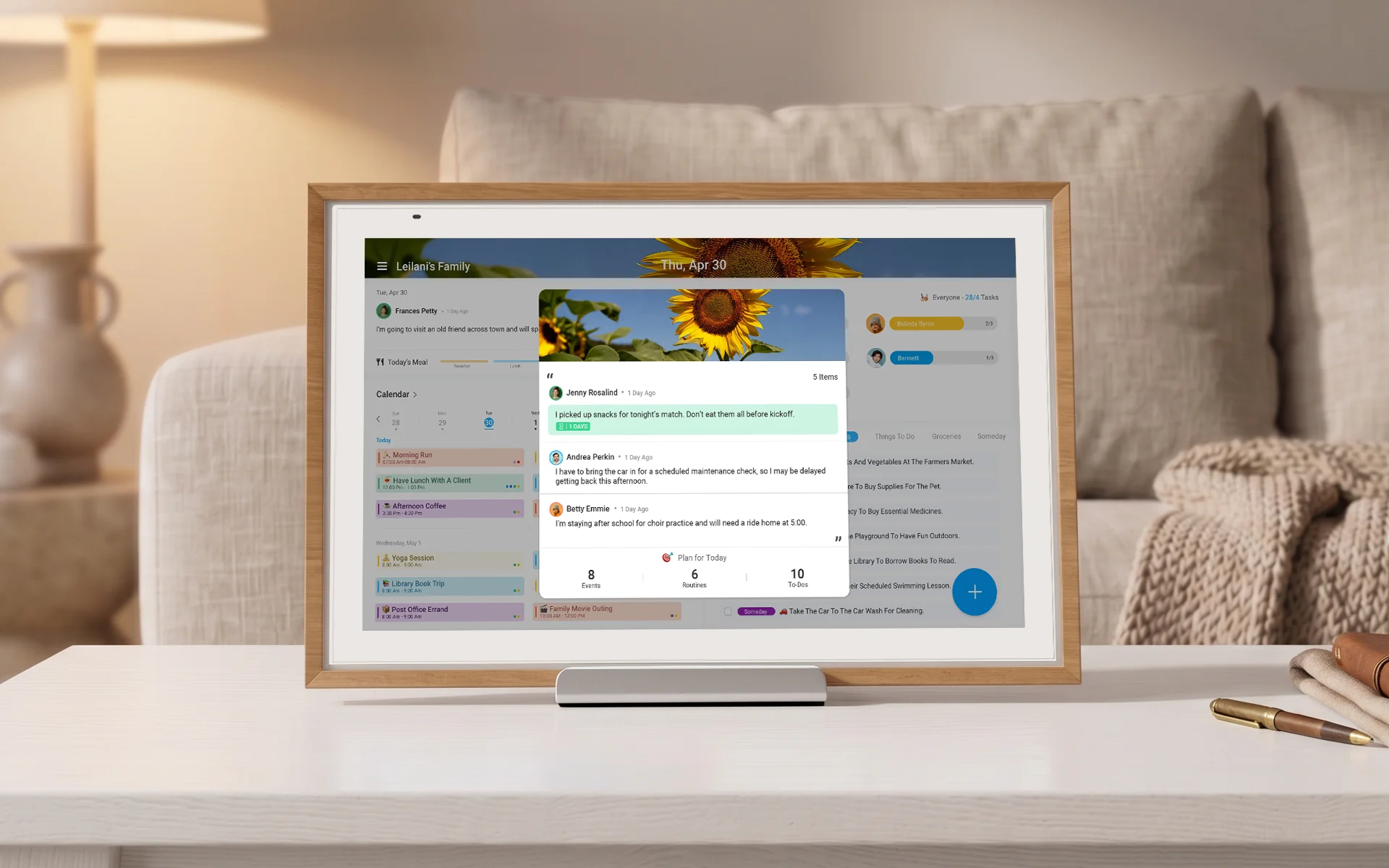
August is when families buy the infrastructure of the school year. Backpacks, planners, and the systems everyone swears will keep the fall organized. It is also when smart family calendars sell hardest, and when the largest number of buyers make a decision without noticing that this category has split into two completely different business models.
One camp sells you hardware and stops. The other sells hardware at a friendly number, then charges annually to keep features you probably assumed you had bought.
Neither approach is dishonest. Both are disclosed. But they diverge sharply across the life of the device, and the crossover arrives earlier than most back-to-school buyers expect. Here is the arithmetic.
The two models, priced
Take the subscription camp first. Skylight's Calendar 2 in the 15-inch size lists at $299.99. Its Plus plan runs $79 per year, with the first month free on a calendar purchase.
What sits behind that paywall is not decoration. The photo screensaver, meal planning, the email-and-PDF import that pulls events in automatically, the kids' rewards system and Disney Mode all require Plus. Color coding, task management, weather and device linking are included free.
Now the buy-once camp. Apolosign's 15.6-inch Digital Calendar is $279, marked down from $349, with no subscription tier at all. Multi-calendar sync across Google, Outlook and iCloud, the chores-and-points rewards system, color-coded to-do lists, the widget dashboard and photo frame mode are included in the purchase price.
At checkout in August, these look like the same product at nearly the same price. They are not the same purchase.
Three school years, added up
| Year 0 | Year 1 | Year 2 | Year 3 | |
|---|---|---|---|---|
| Subscription model (15") | $299.99 | $378.99 | $457.99 | $536.99 |
| Buy-once model (15.6") | $279.00 | $279.00 | $279.00 | $279.00 |
By the end of the third school year the gap is $257.99, which is very close to the entire price of the second device. Put differently, three years of subscription fees buys a whole additional calendar.
The line does not stop there. Five years is a reasonable life for a wall-mounted display with no moving parts, and it covers a child from third grade to eighth. Over five years the subscription path reaches $694.99 while the buy-once path has not moved off $279.
The crossover point is what surprises people. It is not year three or year four. Because the two devices start within about twenty dollars of each other, the very first annual renewal is enough to flip the comparison. From roughly month thirteen, which is to say the start of the second school year, the buy-once device is cheaper, and it stays cheaper for as long as you own it.
Where the subscription model genuinely wins
Three cases, and all three are real.
You are not sure it will stick. A large share of family organization systems bought in August are abandoned by November. A lower cash outlay plus a cancellable annual fee is a cheaper way to discover that about your household than a larger one-time purchase.
You want a specific paywalled feature. Disney Mode has no equivalent anywhere. If themed avatars are what gets a six-year-old to look at the schedule, that feature is doing its job and the fee is buying an outcome.
You replace hardware often. Long amortization arguments assume you keep the device. If you upgrade household electronics every couple of years, the five-year column is fiction for you and you should ignore it.
The honest caveat on the buy-once side
Buy-once stops looking cheap at the top of the size range.
Apolosign's 27-inch is $579 and the 27-inch 4K is $679. Measured against a $299.99 device with a $79 annual plan, neither breaks even inside three years, and the 4K model does not break even inside five. If budget is your binding constraint and a 15-inch screen fits your kitchen, the small model is the one that wins on math. Buying up in size is a decision about your room and your eyesight, not a decision that pays for itself.
There is also a cost that is not money. These calendars stay plugged in and have no battery. Your mounting position is dictated by your outlets. If the wall you actually want has no power behind it, the true cost includes either an electrician or a visible cord running down the wall. Decide which you can live with before you order, not after it arrives in the first week of school.
The question nobody asks before buying
Ask what happens to your data if you stop paying.
On any subscription device, some features are gated and content gets created inside those features. Meal plans, imported events, photo libraries and reward histories all live somewhere. Whether they remain visible, become read-only or disappear on cancellation is a policy question that varies by vendor and changes over time.
The point is not that any particular company handles this badly. The point is that the answer determines whether your subscription is genuinely cancellable or only theoretically cancellable, and it is far easier to establish in August than in year three. Read the current terms before you buy, and re-read them if you ever plan to stop.
A device with no subscription simply does not have this failure mode, which is worth something that never appears in a price comparison.
What actually drives the total
Three factors, in descending order of impact.
How long you keep it. Under a year, the two models are roughly equivalent and the comparison is not worth your time. Past two school years, the recurring fee dominates every other variable, and no hardware discount catches up to it.
How many paid features you would truly use. If you would never touch meal planning or auto-import, the subscription's effective price is buying you a screensaver. Read the free-versus-paid split line by line before purchase, not after.
Household size. More people means more calendars to merge, which is exactly where multi-source sync earns its keep. A single-child, single-calendar household is a much simpler purchase and can reasonably skip this entire analysis.
Shift your way of evaluating price
Do not treat the sticker price as your full cost; treat it as a down payment, and calculate total expense over the next 36 months.
From this perspective, a $299.99 display with a $79-per-year subscription effectively costs $536.99 over three years, while the $279 buy-once unit stays at $279. Both options are valid choices for different household priorities. Yet only one of these two shows you the full lifetime cost at checkout. During the busy back-to-school shopping season, when families make dozens of purchasing decisions quickly, understanding this distinction is the core of smart shopping.
For most households planning to keep their wall calendar multiple school years, total long-term cost deserves just as much attention as the upfront sticker price.
All prices verified August 7, 2026 and subject to retailer promotions and updates.