Four Under Forty: The 2026 Fields Medal Goes to Deng, Pardon, Tsimerman, and Wang — and One Is a Stanford Alum
The 2026 Fields Medal went to Yu Deng, John Pardon, Jacob Tsimerman and Hong Wang, spanning PDEs, symplectic geometry, arithmetic geometry and the Kakeya problem. Pardon is a Stanford PhD.

Stanford Tech Review editorial desk.
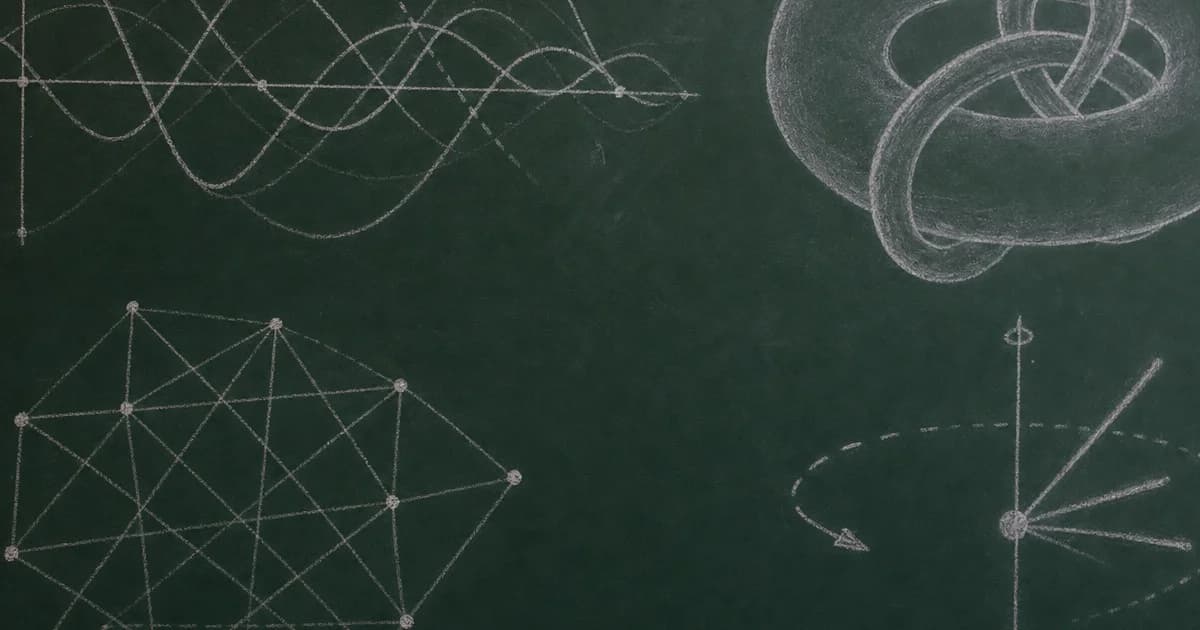
At the International Congress of Mathematicians on July 23, the discipline's highest honor went to four mathematicians working in North America — spanning fluid dynamics, symplectic geometry, arithmetic geometry, and a century-old problem about a spinning needle
The Nobel of Mathematics, Awarded Once Every Four Years
There is no Nobel Prize in mathematics. The Fields Medal is what the field has instead — and it is arguably harder to win. It is awarded only every four years, at the International Congress of Mathematicians, to at most four people, and only to those under the age of 40. That age cap makes it as much a bet on a career's future as a reward for work already done.
This week the 2026 medals were announced, and they went to four researchers: Yu Deng, John Pardon, Jacob Tsimerman, and Hong Wang. It is the first time two mathematicians of Chinese descent have won in the same cycle, and the third time in the medal's history that a woman has been honored. All four are based at North American institutions.
For readers close to Stanford, there is a local thread worth pulling: John Pardon earned his PhD at Stanford before the work that would eventually put him on this list.
The Four Winners, and What They Actually Work On
Mathematics at this level is notoriously hard to explain, but each of these citations points at a concrete, nameable achievement.
Yu Deng — University of Chicago
Deng works in partial differential equations, the mathematics of how things flow, wave, and diffuse. His most celebrated result is a rigorous derivation of the Boltzmann equation — the fundamental equation of gas dynamics — directly from the underlying physics of individual particles bouncing off one another (hard-sphere dynamics) in a dilute gas. It is a problem that sat open, in one form or another, for over a century: connecting the microscopic world of colliding molecules to the macroscopic equation engineers actually use. He has done related foundational work on wave kinetic equations.
John Pardon — Stony Brook University (PhD, Stanford)
Pardon is honored for his work in symplectic geometry, the geometry that underlies classical mechanics and much of modern mathematical physics. Among his results is a proof of the roughly two-decade-old MNOP conjecture, which showed that two seemingly different ways of counting curves on certain higher-dimensional spaces (Calabi–Yau 3-folds) are in fact the same — a bridge between geometry, quantum physics, and representation theory. He is now a professor at Stony Brook's Simons Center for Geometry and Physics, but the through-line of his career runs back through his Stanford doctorate.
Jacob Tsimerman — University of Toronto
Tsimerman works at the intersection of number theory and algebraic geometry. He is recognized for pushing "o-minimality" — a set of techniques from mathematical logic — deep into arithmetic geometry, most notably in his proof of Griffiths' conjecture on period maps. In plain terms, he brought tools from one corner of mathematics to settle long-standing structural questions in another, a kind of cross-disciplinary translation that the field prizes highly.
Hong Wang — New York University and IHES (France)
Wang works in harmonic analysis and geometric measure theory. Her headline result is a solution to the three-dimensional Kakeya problem — a deceptively simple-sounding, century-old question: what is the smallest region in which you can rotate a needle to point in every possible direction? The answer turns out to encode deep truths about how sets, dimensions, and oscillation interact, with ripple effects across analysis and even into questions in computer science.
Why a Math Prize Is Worth Your Attention
It is tempting to file the Fields Medal under "abstract and remote." That would be a mistake. The Boltzmann equation Deng put on rigorous footing sits inside every fluid and aerodynamics simulation. The symplectic and curve-counting machinery Pardon advanced is the mathematical grammar of string theory and quantum field theory. Tsimerman's arithmetic-geometry results feed the number theory that modern cryptography rests on. And the harmonic analysis Wang works in is quietly foundational to signal processing and, increasingly, to the theory behind machine learning.
The people who win this medal in their thirties tend to define the mathematical infrastructure the rest of us are still using decades later. The 2026 class — a fluid dynamicist in Chicago, a Stanford-trained geometer on Long Island, a logician-turned-number-theorist in Toronto, and an analyst splitting time between New York and Paris — is a fair snapshot of where the frontier of the subject sits right now.
Sources: Simons Foundation, Stony Brook University, Quanta Magazine, Nature, and Scientific American. Research descriptions are summarized from the official citations; any simplification is ours.