Who Is John Ternus? Apple's Next CEO After Tim Cook
John Ternus becomes Apple's eighth CEO on September 1 — the first promoted from its own hardware engineering org. What his background predicts.

Priya Raman is a staff writer at Stanford Tech Review covering AI, semiconductors, and emerging technologies across Silicon Valley.
On September 1, John Ternus becomes Apple's eighth chief executive, taking over from Tim Cook, whose last day in the job is August 31. The transition was announced by Apple on April 20 and takes effect after a summer-long handover in which Cook and Ternus worked side by side. Cook becomes executive chairman of the board; Arthur Levinson, chairman since 2011, becomes lead independent director.
Most coverage of the transition has focused on Cook's legacy. The more consequential question is the one in the other direction: who is the person now running the most valuable company in the world, and what does his background predict about how he will run it?
The résumé: 25 years inside Apple's hardware org
Ternus, 50, is a mechanical engineer. He graduated from the University of Pennsylvania with a degree in mechanical engineering, spent four years at Virtual Research Systems, a small maker of virtual-reality headsets, and joined Apple's product design team in 2001. He became a vice president of hardware engineering in 2013, joined the executive team as senior vice president of hardware engineering in 2021, and by the end oversaw the hardware engineering behind every major Apple product line: iPhone, iPad, Mac, Apple Watch, AirPods, and Vision Pro.
That path makes him a specific kind of first. Apple has been run by salesmen, marketers, turnaround specialists, a founder, and an operations expert. It has never before promoted a CEO out of its own hardware engineering organization.
| # | CEO | Tenure | Background |
|---|---|---|---|
| 1 | Michael Scott | 1977–1981 | Manufacturing (National Semiconductor) |
| 2 | Mike Markkula | 1981–1983 | Investor, marketing (Intel) |
| 3 | John Sculley | 1983–1993 | Consumer marketing (PepsiCo) |
| 4 | Michael Spindler | 1993–1996 | Sales and marketing (Apple Europe) |
| 5 | Gil Amelio | 1996–1997 | Semiconductors (National Semiconductor) |
| 6 | Steve Jobs | 1997–2011 | Co-founder, product |
| 7 | Tim Cook | 2011–2026 | Operations (Compaq, IBM) |
| 8 | John Ternus | 2026– | Hardware engineering (Apple) |

One number worth fixing in place as the era closes: measured from appointment to departure, Cook leaves as the longest-serving CEO in Apple's history at 15.0 years, ahead of Steve Jobs at 13.9 years counting from his interim appointment in September 1997. No one else held the job for even eleven.
What the hardware background actually predicts
Reading a CEO's future from their résumé is a mug's game in general, but Apple is an unusually legible company: its org chart is functional rather than divisional, so the CEO's own function historically tilts where attention and internal power flow. Under Cook, an operations expert, Apple perfected its supply chain, margins, and services attach rates. Under Ternus, the reasonable base case is that hardware velocity gets the benefit of the doubt in internal arguments.
There are three concrete signals beyond the org chart:
The decisiveness reports. MacRumors reported that Apple's board saw in Ternus "a more decisive leadership style" compared with Cook's consensus style, a Jobs-like quality that colleagues have echoed in profiles in The New York Times and Bloomberg over the past year. Decisiveness in a functional org means faster kills and faster bets; the products most exposed to that are the ones still searching for their market, above all Vision Pro, which has struggled for adoption since its 2024 launch.
The Srouji promotion. Announced the same day: Johny Srouji, Apple's silicon chief, becomes chief hardware officer, an expanded role that absorbs hardware engineering, per CNBC. Elevating the silicon organization to own all of hardware, under a hardware-engineer CEO, concentrates product authority in the functions that build things, at exactly the moment Apple's biggest strategic exposure, the AI buildout, is a silicon and memory problem as much as a software one.
The mentorship framing. Ternus's own statement named both of his predecessors: he spoke of working "under Steve Jobs" and having "Tim Cook as my mentor." The sequencing is doing work there. The product culture is the inheritance he claims; the operating discipline is the apprenticeship he acknowledges.
The long runway
None of this arrived suddenly. The Financial Times reported in late 2025 that Apple had intensified its succession planning with Ternus seen as the frontrunner, and by January 2026 the profiles had begun treating him as the presumptive heir. Apple's board made the formal appointment on a Friday in April, per the company's securities filing, and announced it the following Monday. The result is one of the most heavily telegraphed CEO transitions in tech history, the opposite of the 2011 handover, which was compressed by Steve Jobs's failing health.
Apple watchers also already know Ternus as a performer. For years he has fronted the keynote segments where new Macs and iPads were introduced, which means the September 9 iPhone event, his first as CEO and eight days into the job, will feature a presenter most of the audience has seen on that stage many times. That familiarity is an underrated asset: Apple's CEO is also its chief salesman, and the board has had a decade of film on how Ternus handles the room.
The inheritance is not clean
Ternus takes over a company setting all-time quarterly revenue records, with an installed base above 2.5 billion devices and a services business generating more than $100 billion a year. He also inherits the least settled operating environment Apple has faced in a decade: US tariffs and geopolitical pressure on a supply chain still anchored in Asia, and a memory market squeezed by AI-datacenter demand for DRAM that raises the cost of every device Apple ships.
And he inherits a deadline. Apple's next flagship event is September 9, eight days after he takes office, where the company is expected to show its first foldable iPhone alongside the iPhone 18 Pro line. Cook got 41 days before his first launch event as CEO in 2011. Ternus gets eight.
The definitional point, the one to hold onto as the profiles pile up: Apple's eighth CEO is the first one the company grew entirely inside its own labs. Every previous transition imported its answer, from Pepsi, from National Semiconductor, from IBM by way of Compaq, or re-imported the founder. This one was manufactured in-house, over 25 years, by the same product-development machine it now hands him.
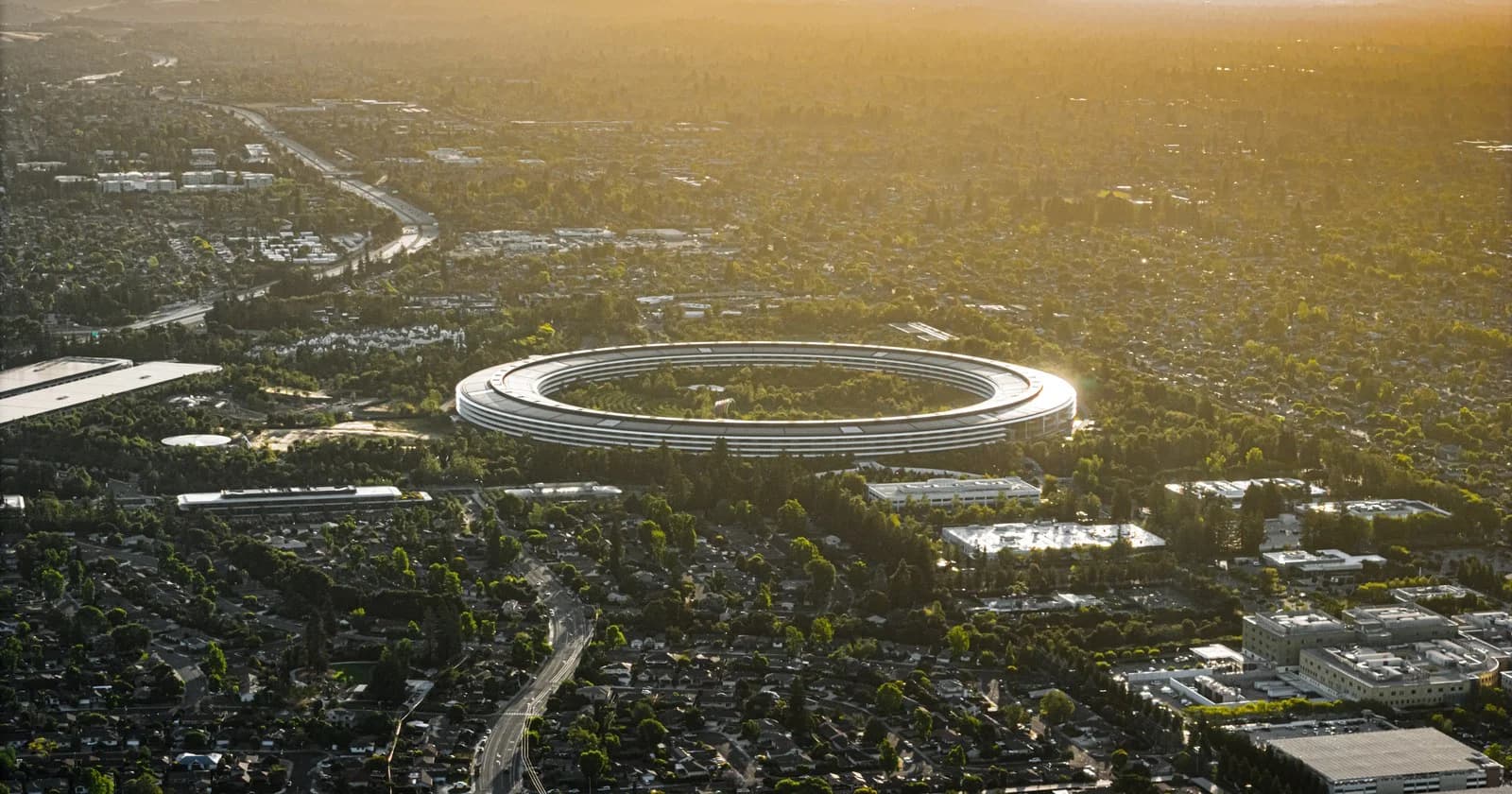
Cover: aerial view of Apple Park, Cupertino, June 2024 (photo: Nils Huenerfuerst, CC0, via Wikimedia Commons). Chart: Stanford Tech Review; method noted on figure.