Terence Tao, OpenAI, and Who Owns Mathematics
The AHM statement hosted on Terence Tao's blog says mathematicians did not ask for OpenAI's 700-file math release. On Tao's own blog, 53 of 103 comments rejected it.

Elena Marsh covers science policy for Stanford Tech Review, with a focus on federal research funding, biosecurity oversight, and how Washington governs the labs it pays for.
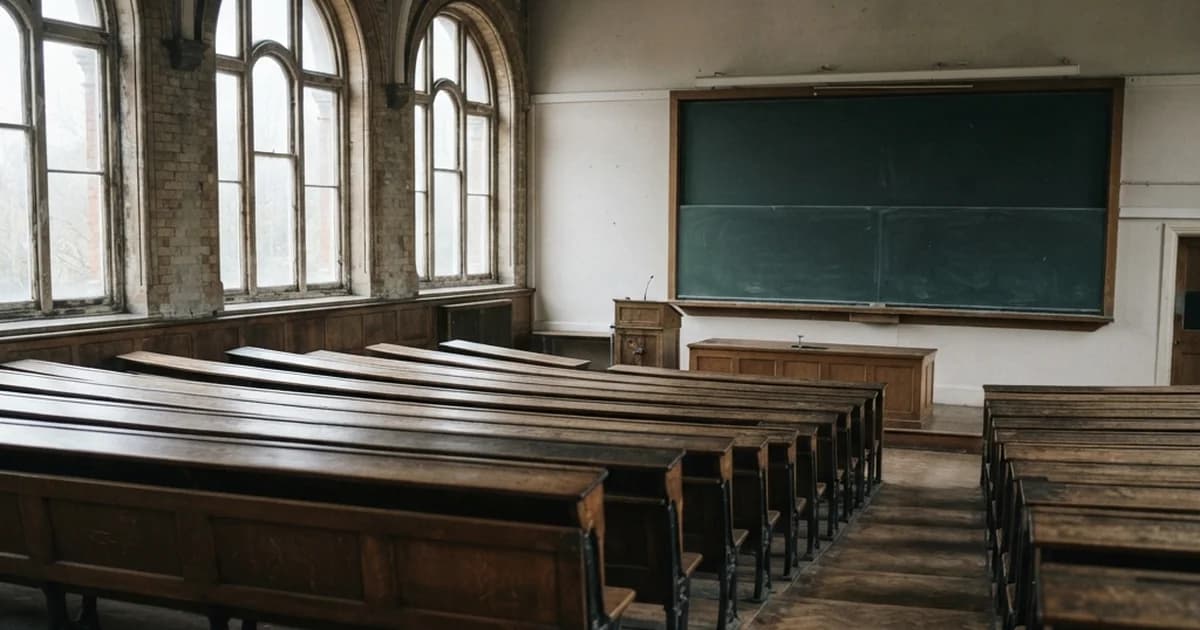
On October 6, 2026, OpenAI published a repository of more than 700 manuscripts claiming solutions to open problems in mathematics. One day later, a statement from the Association for Human Mathematics appeared on the most-read blog in the discipline, Terence Tao's What's new, reposted from the association's own statements page. Its second sentence is the one that travelled: "Mathematicians did not ask for this work to be done."
That sentence is the problem. Not because it is rude, and not because OpenAI deserves deference, but because it asserts a right that does not exist. Nobody asked Perelman to settle the Poincaré conjecture. Nobody asked Galois whether the profession would like to hear about the solvability of quintics. An open problem is open. The word is doing real work there, and the statement spends four paragraphs pretending it does not.
What the statement actually claims
Stripped of tone, the AHM text makes four distinct claims. They are worth separating, because only one of them is about mathematics.
| Claim in the statement | What kind of claim it is | Checkable? |
|---|---|---|
| OpenAI faces plagiarism, copyright and trademark suits | Legal, about the company | Yes, and irrelevant to whether a proof holds |
| "Mathematicians did not ask for this work to be done" | Jurisdictional — who may attempt a problem | No; it asserts standing, not fact |
| The release "does not advance our subject" | Mathematical | Yes, and testable file by file |
| 700 files at once is "a demonstration of power" | Rhetorical | No |
Only the third claim can be settled the way mathematics settles things. It is also the only one the statement declines to support with a single example. No incorrect lemma is named. No file is cited. The document rejects a body of work in the aggregate, which is precisely the move the discipline exists to forbid.
The first claim is stranger still. Copyright litigation has no bearing on whether a proof is valid. Mathematics is the rare field where provenance is irrelevant to truth: a correct argument discovered by a thief, a child, or a language model is a correct argument. Leading with the lawsuits tells the reader that the objection is about the author, which is the oldest disqualified move in the subject.
On Tao's own blog, the room disagreed
The statement landed in the most sympathetic venue available to it — a mathematician's blog, read overwhelmingly by mathematicians, with the field's most decorated living member's name at the top of the page. It still lost the room.
We read all 103 comments on the post individually and classified each by stance toward the statement, rather than by keyword. Fifty-three rejected it, thirty-two supported it, and eighteen were neutral or procedural — a margin of 1.66 to 1 against, in the friendliest house the statement will ever enter.

Method: every comment on the post as of October 9, 2026 was read and assigned one of three stances. Replies count as individual comments. Source: the post's own comment thread.
The dissent is not coming from outside. A PhD student in algebraic geometry wrote that he disagrees, "and basically all the people I know in my department." Another commenter, Jörg Neunhäuserer, reported having worked on three of the problems in the release — numbers 146, 148 and 153 — and spending "quite a lot of my life trying to find proofs for them." His reaction was not grief. He described himself as relieved, and "a little proud that my mathematical intuition turned out to be right in all three cases."
One commenter put the structural objection more precisely than the statement puts its own case: the AHM's central argument "is not a mathematical objection; it is a jurisdictional one." Another observed that the association's roughly 800 signatories amount to under one percent of professional academic mathematicians, and concluded simply: "They do not own math."
That line, in various forms, recurs through the thread more than any other. "Mathematics does not belong to mathematicians." "You, or anyone else for that matter, don't own mathematics." "It reads as if these people think mathematics is their private property." The people saying this are reading a statement that claims to speak for them.
The part about Tao
The statement is a guest post. Tao did not write it, and prominent AI-positive guest posts by other mathematicians have appeared on the same blog. That distinction is real and it is being lost: the post now circulates on X as Tao's position, with one widely shared quote-post calling it "deeply embarrassing" and another answering it with a single line — that the taxi industry does not acknowledge the existence of Uber.
But hosting is not neutral. A commenter asked him directly to add a note at the top clarifying that he is not an AHM member and that the view is one among many. As of this writing, no such note has appeared, and the post carries his byline, his tags, and his readership. The most authoritative platform in mathematics was lent to a document urging mathematicians to stop working with a research lab, and the lending is itself an editorial act.
The entitlement in the statement is not Tao's invention. It is, however, now flying under his flag, and the people most damaged by that are the mathematicians it claims to represent — including the ones in his own comment section saying it does not.
The legitimate objections, which the statement buries
There are real criticisms of the October 6 release, and the AHM text makes almost none of them.
The repository itself states the numbers plainly: 719 manuscripts across 372 result families, with "~42% top-line results formalized" in Lean. OpenAI's own README concedes that "some of the unformalized results could have issues," and the project has already recorded retractions in its history file after flaws were found. So roughly three in five top-line results currently rest on unverified natural-language argument.
Even a Lean certificate is not a complete guarantee. A recent arXiv paper, Navier-Stokes lost in translation, argues that verifying an autoformalization does not establish the correctness of the natural-language proof it was derived from — the translation step itself can fail silently. The Advisory Group on Mathematics and Artificial Intelligence asked for prompts and failed attempts to be released; OpenAI published excerpts for about ten problems, which is not that.
Every one of those is a procedural complaint that a skeptical mathematician could press hard, publicly, and win. Verification burden is a real cost, dumped on a profession that did not volunteer for it. Transparency about failures is a reasonable demand. A statement built on those points would have been difficult to answer.
Instead the document opened with the lawsuits, claimed to speak for everyone, and ended by urging a boycott. It converted a winnable argument about method into an unwinnable one about ownership.
Mathematics belongs to everyone
The deepest error in the statement is the premise beneath all four claims: that mathematics is the property of the people currently employed to do it, and that progress requires their permission.
It does not, and it never has. "Mathematicians did not ask for this work to be done" is, as a historical claim, simply false. Paul Erdős spent decades asking — publishing open problems to anyone who would read them and attaching his own cash prizes, from twenty-five dollars to several thousand, precisely because he wanted strangers to attempt them. He did not vet the solvers. The entire point of publishing a problem is to recruit people you have never met and cannot screen.
Ramanujan was a clerk in a port office. Fermat was a lawyer. Perelman had no institutional position when he posted his Poincaré proof to arXiv, and refused the Fields Medal and the million dollars that followed. None of them were asked. Each of them is now standard curriculum. The subject's entire claim to universality — the reason a theorem is true in every country and every century — is that it answers to proof rather than to credentials. A community that starts gatekeeping who may attempt a problem has abandoned the only thing that made its results worth trusting.
What a profession can legitimately demand is rigour: formalize the rest, publish the failures, name the errors, retract fast. What it cannot demand is a veto over who gets to try. The first is a standard, and standards are how mathematics defends itself. The second is a guild, and guilds are how a subject stops being universal.
Mathematics has no owners. An open problem is open to anyone who can attempt it, and the only question that was ever legitimate to ask of an answer is whether it is correct. Check the 700 files. Retract what fails. Keep what holds. That is the discipline working, and it does not require anyone's permission to begin.