Physical AI Moves Machines From Screens Into the Real Economy
A data-driven perspective on Physical AI (AI in the real economy) and its impact on manufacturing and industrial operations.

Data journalist covering markets, platforms, and the economics of rating systems.
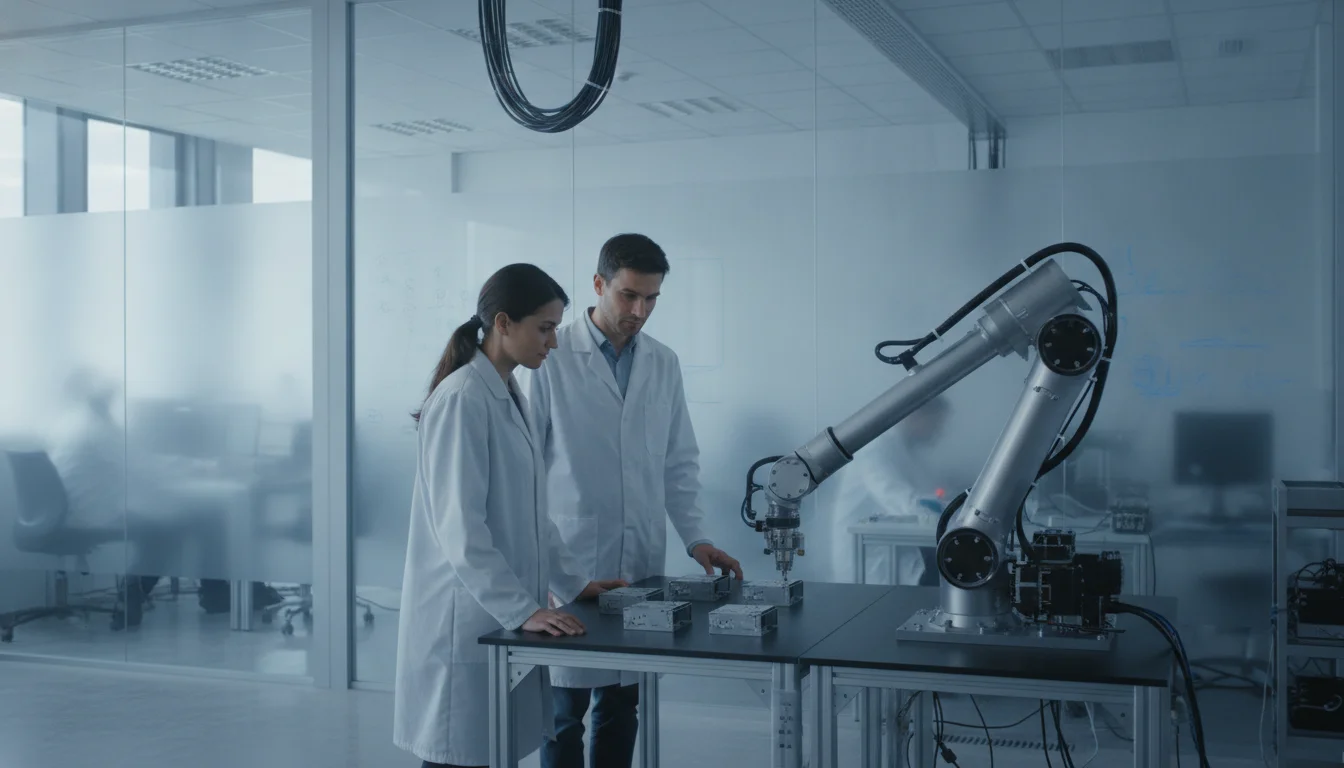
The AI revolution isn’t only about chatbots or clever software dashboards. It’s about machines that can sense, reason, and act in the real world—sometimes without human guidance. This emergent capability—what many call Physical AI (AI in the real economy)—isn’t a distant fantasy. It is becoming a near-term strategic imperative for manufacturers, utilities, logistics operators, and energy networks. The question before leaders today is not whether to adopt Physical AI, but how fast, how safely, and with what governance to maximize value while protecting workers and communities. This perspective from Stanford Tech Review argues that Physical AI represents the next industrial leap, one that blends sensing, interpretation, autonomous action, and learning across the entire industrial stack. It’s a move from isolated pilots to scalable, end-to-end deployments that reshape the economics of production, maintenance, and service delivery. The key thesis: the real value of AI arises when it is embedded in the physical world—on the factory floor, in the warehouse, and along the supply chain—and managed through a disciplined lifecycle that pairs technology with people, process, and policy. This piece outlines how we got here, why the conventional wisdom is often incomplete, what a disciplined path to scale looks like, and the broader implications for business strategy, workforce development, and governance. The conversation around Physical AI is evolving quickly, and the best path forward is grounded in data, validated by pilots, and deployed with a clear plan for scale and risk management. (reports.weforum.org)
Section 1: The Current State
Prevailing assumptions about AI in industry
Many readers still frame AI in industry as a software problem: dashboards that predict failure, optimize schedules, or recommend product configurations. The prevailing narrative often treats the factory floor as a separate domain where automation and robotics live apart from the core AI stack. Yet the most compelling framings of Physical AI argue that intelligence in the real world demands an integrated technology stack—one that couples perception with decision-making and physical action in real time. The World Economic Forum emphasizes that Physical AI is about embedding a new technology stack into industrial operations, extending beyond discrete automation to a more autonomous, adaptable, and resilient operation model. This shift elevates robotics and AI from a “nice-to-have” to a core capability in the industrial playbook. The emphasis on an end-to-end technology stack and ecosystem partnerships signals a fundamental redefinition of what it means to deploy AI in production environments. (reports.weforum.org)
Where Physical AI is already deployed and why it matters
Across manufacturing and related sectors, Physical AI is moving from isolated pilots to production-scale deployments. Deloitte’s Physical AI dossier catalogues a wide range of use cases—ranging from digital twins and simulation-first development to autonomous laboratory and manufacturing workflows—that illustrate how AI can operate inside physical systems rather than merely in software simulations. In practice, these capabilities support faster design-test cycles, safer operations, and more reliable quality control for complex products. The World Economic Forum’s research also highlights real-world manifestations on factory floors—robotic systems that can adapt to changing inputs, perform with greater precision, and coordinate with human operators in dynamic environments. Where firms once piloted AI in a single function, they are now pairing sensors, digital twins, edge compute, and autonomous agents to create more flexible and resilient production ecosystems. The Tata Consultancy Services study released in 2026 further demonstrates mainstream manufacturing interest, including significant expectations around workforce augmentation and safety improvements as Physical AI becomes more deeply integrated into operations. These sources collectively show that the current state is shifting from experiments to integrated, value-driven deployments. (deloitte.com)
Gaps between pilots and production and what it takes to close them Despite momentum, experts warn that many pilots fail to translate into durable, scalable production. A consistent theme across industry analyses is the need for an integrated approach that combines data governance, hardware-software co-design, safety and risk management, and workforce transformation. Gartner’s body of work for 2026 positions Physical AI as a strategic trend with real enterprise implications, and it highlights the challenges of scaling—especially for enterprises without mature data infrastructure, cross-functional governance, or a clear ROI framework. The World Economic Forum also notes that successful scaling requires not only new tools but new partnerships and investment in workforce capabilities. Addressing these gaps requires a deliberate, lifecycle-conscious approach to Physical AI deployment, rather than treating it as a set of isolated experiments. (gartner.com)
Section 2: Why I Disagree
Physical AI is more than robots; it’s a holistic technology stack My central position is that Physical AI is not merely the next generation of robotics or a set of automation quirks. It is an integrated stack that spans sensing, perception, decision-making, control, and learning—applied to physical entities such as machines, vehicles, and infrastructure. The Bank of America Global Research report on Physical AI frames it as a shift from purely digital systems to machines that sense, reason, and act in the real world, and to do so safely and productively. This framing aligns with the World Economic Forum’s description of a new physical AI technology stack, underscoring that the value resides in end-to-end integration rather than isolated capabilities. IBM’s and EY’s perspectives reinforce this view by describing how physical AI combines world models, synthetic data, and autonomous policy evaluation to move from concept to deployment. In short, the edge of AI is not the model alone; it is the entire loop that turns perception into action in concrete environments. (institute.bankofamerica.com)
End-to-end deployment yields the real ROI, not pilot-level improvements
A recurring theme from leading consultancies is that the most significant economic value comes when AI is deployed end-to-end across the operation, not just in a single process. McKinsey’s work on AI in manufacturing emphasizes “lighthouse” sites that demonstrate the full value of AI by linking design, production, and supply chain planning. Their analyses show that leading enterprises can achieve multi-dimensional performance improvements when AI is embedded throughout operations, including engineering design, product configuration, and process optimization. More recent McKinsey material argues that autonomous, AI-driven production—enabled by digital twins, AI agents, and continuous feedback loops—can substantially elevate productivity in discrete manufacturing and logistics. The emphasis on end-to-end integration—and the role of digital twins and AI agents—supports the view that Physical AI’s power lies in the orchestration of multiple capabilities, not in a single breakthrough. (mckinsey.com)
Workforce transformation is a prerequisite, not an afterthought
Critics sometimes argue that advanced AI will simply replace human labor. The data tell a different story in the near term: manufacturers expect workforce augmentation and safety benefits as Physical AI scales. The Tata Consultancy Services study in 2026 highlights a sizable portion of manufacturers anticipating significant workforce augmentation—driven by improvements in safety and the ability to support workers in hazardous or repetitive tasks. This aligns with broader labor-market research that points to shifts in job profiles and skill requirements, with AI enabling new kinds of collaboration between humans and machines rather than a wholesale displacement of work. While it is prudent to acknowledge mobility and wage dynamics in a rapidly changing economy, the consensus among major industry players is that upskilling and new roles will accompany adoption rather than be eliminated by it. (tcs.com)
Governance, safety, and risk management are fundamental, not optional
A common misstep is to treat AI deployments as purely technical projects. In the real world, Physical AI introduces governance and safety considerations that extend beyond software reliability. The academic and industry literature increasingly emphasizes lifecycle governance for Physical AI—defining how research, data, models, deployment, and monitoring work together within safety and compliance constraints. The World Economic Forum’s 2025 white paper explicitly calls for embedding governance practices within the Physical AI lifecycle and for creating partnerships that support workforce transformation. The emergence of governance-focused research and practitioner guidance signals that responsible deployment is essential to realizing value in industrial contexts. These considerations cannot be an afterthought; they are core to the economics of Physical AI adoption. (reports.weforum.org)
Addressing counterarguments with data-driven nuance
Some observers warn that the hype around Physical AI could outpace the practical reality of integration, particularly given cybersecurity concerns, data quality challenges, and the complexity of coordinating across suppliers, vendors, and internal teams. While these concerns are valid, the evidence base suggests that a structured, lifecycle-based approach can reduce risk and accelerate value. Industry analyses from Gartner and McKinsey show that guided, phased deployments—rooted in data governance and cross-functional collaboration—are associated with stronger performance gains than isolated pilots. The broader literature on AI in manufacturing also acknowledges the risk of displacement and calls for proactive governance and workforce transition planning to mitigate social impacts. Time and again, the most credible forecasts describe not a binary replacement of humans by machines, but a reconfiguration of work processes in which people and Physical AI systems collaborate to achieve outcomes that neither could reach alone. (gartner.com)
Section 3: What This Means
Implications for strategy, operation, and policy
Build the end-to-end Physical AI stack, not just pilots Executives should prioritize an architectural approach that integrates sensing, perception, decision-making, actuation, and learning with robust data governance and safety controls. This means investing in sensor fusion platforms, edge compute, digital twins, and simulation environments that allow policy evaluation and iteration before field deployment. The World Economic Forum’s framework emphasizes a new technology stack and ecosystem partnerships as prerequisites for scaling Physical AI across the value chain. The emphasis here is not on chasing a single breakthrough but on constructing a reliable operational fabric that can adapt to changing conditions, demand patterns, and supply constraints. The payoff is higher throughput, better quality, and safer operations that are sustainable at scale. (reports.weforum.org)
Treat workforce and governance as core levers, not afterthoughts The industry consensus is clear: to capture the value of Physical AI, firms must invest in people, governance, and change management in parallel with technology. This includes redesigning jobs, creating new roles around AI-augmented operations, and upskilling workers to collaborate with autonomous systems. It also means implementing lifecycle governance—designing workflows that ensure safety, reliability, and accountability for AI-driven actions in physical environments. The TCS study and WEF reports highlight workforce transformation as a central driver and enabler of durable deployment. Leaders should plan for retraining, new career pathways, and transparent communication with employees about how AI will alter workflows, safety practices, and decision rights. (tcs.com)
Embrace ecosystem partnerships and standards No single vendor can deliver every piece of the Physical AI stack or manage all governance complexities alone. Successful scale hinges on ecosystem collaboration—between hardware suppliers, software platforms, integrators, and even customers and regulators. The WEF white paper on Physical AI emphasizes ecosystem partnerships as a critical lever for industrial transformation, while Gartner’s and McKinsey’s work stresses the importance of cross-organizational collaboration and shared practices to accelerate value realization. Firms should pursue strategic partnerships and participate in industry standards initiatives that reduce integration risk, improve interoperability, and accelerate time-to-value. (reports.weforum.org)
Strategically align with productivity and resilience goals Physical AI is not only about productivity gains; it also supports resilience by enabling real-time monitoring, adaptive control, and safer operations in hazardous environments. The World Economic Forum describes how inline sensors, chemistry-aware analytics, and embodied robotics can improve process stability, safety, and adaptability in both discrete and process manufacturing. In practice, leaders should connect Physical AI initiatives to a broader strategy that includes supply chain resilience, cost-to-serve improvements, and customer-centric flexibility. This alignment is increasingly reflected in business analyses from top consultancies that tie AI deployment to measurable performance improvements across design, manufacturing, and logistics. (weforum.org)
Stay attuned to regulatory and social dimensions As Physical AI becomes more embedded in critical infrastructure and high-stakes environments, policy and social considerations will matter more. The technology’s interface with safety, employment, and accountability requires thoughtful governance and engagement with policymakers, workers, and communities. The literature on governance, along with job-market analyses, suggests that proactive policy design and responsible deployment practices will shape adoption trajectories and social outcomes. Organizations should engage with regulators and industry bodies to co-create guidance that protects safety and workers’ interests while enabling innovation. (arxiv.org)
Closing
In sum, Physical AI (AI in the real economy) is not a speculative future but a practical, near-term imperative for organizations seeking to remain competitive in a world where physical systems must reason and act as capably as digital ones. The current momentum—from pilots that prove concept to deployments that redefine cost structures, reliability, and safety—shows that the next industrial leap is not about replacing humans with machines but about enabling smarter, more capable collaboration between people and intelligent machines. The path forward requires a disciplined combination of end-to-end technology stacks, workforce transformation, governance, and ecosystem partnerships. Leaders who embrace this integrated approach will unlock sustainable productivity gains, stronger resilience, and new economic value across manufacturing, logistics, energy, and related sectors. The question for Stanford Tech Review readers is not whether to pursue Physical AI, but how to design and govern implementations that deliver durable, responsible value for the real economy. The era of intelligent industrial operations has arrived, and the time to act is now. (reports.weforum.org)