AI Data Center Guarantee Tracker: Nvidia, Meta, Google
A maintained record of disclosed AI data center guarantees: Nvidia's $105B residual value guaranties for OpenAI's Ohio campus, Meta's $41B across two ventures, and Alphabet's $43.8B of credit backstops, each traced to its filing.

Data journalist covering markets, platforms, and the economics of rating systems.
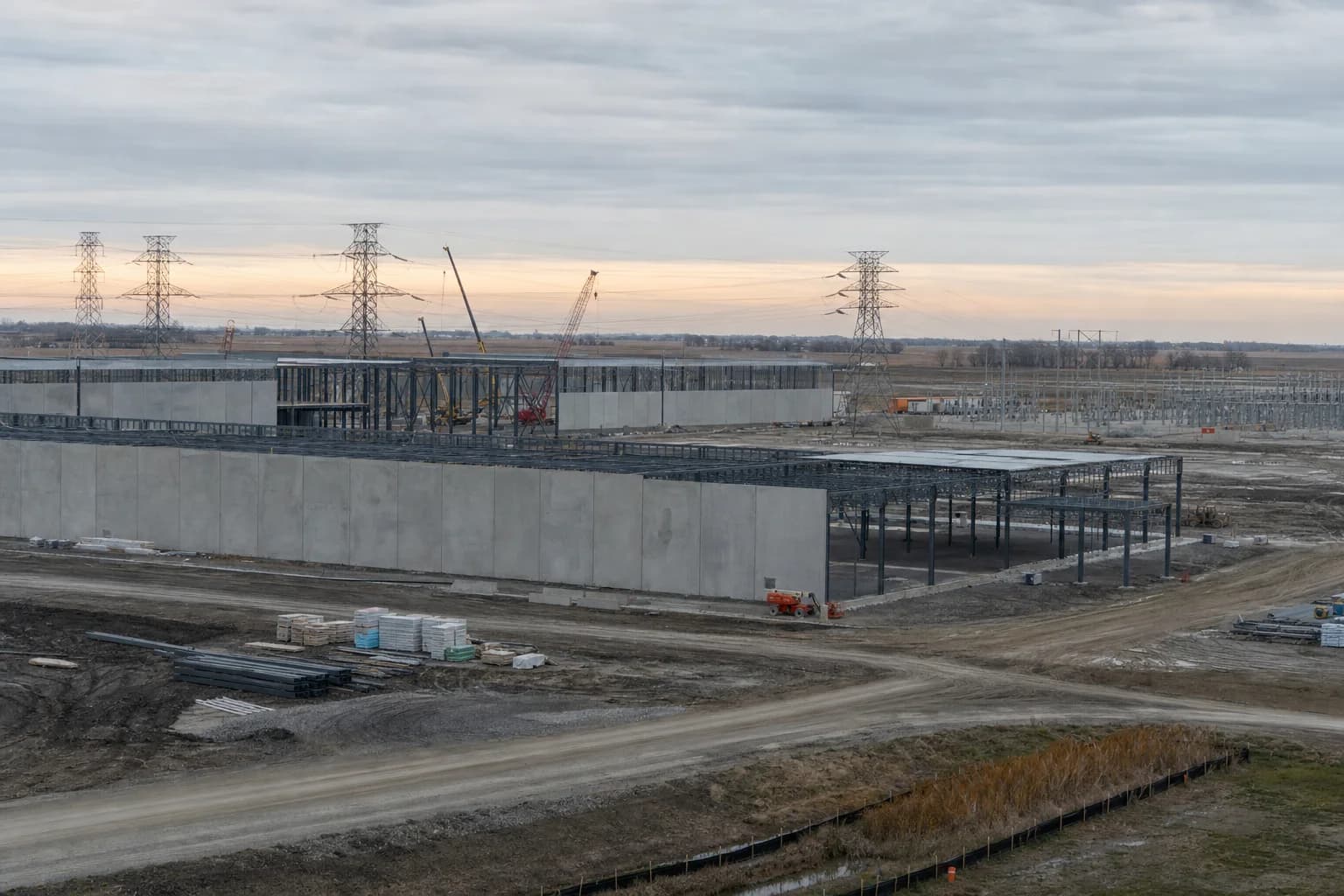
Three American companies have now promised to cover other people's data center obligations, and the disclosed maximum exposure across them is $189.8 billion. No filing, index or news report states that total, because each company discloses its share in a different note, under a different name, using a different accounting treatment. This page is the census.
The widely quoted figure for this activity is around $70 billion. Nvidia's single Ohio disclosure exceeds it.
The record
| Guarantor | Beneficiary / tenant | Max exposure | Instrument | Accounting treatment | Primary source |
|---|---|---|---|---|---|
| Nvidia | OpenAI (tenant), SB Energy (lessor) — PORTS-Pike, Ohio | $105.0B | Residual value guaranties on 20-year leases | Off-balance-sheet contingent commitment; no liability recorded | Form 8-K, filed Aug 17, 2026 |
| Meta | Louisiana data center venture (20%-owned) | $28.0B | Residual value guarantees, threshold decreasing over time | "RVG payments are not probable, and therefore no liability has been recorded to date" | Form 10-Q (Q2 2026), filed Jul 30, 2026 |
| Meta | El Paso, Texas venture (20%-owned, pending close) | $13.0B | Residual value guarantees | Disclosed as a subsequent event; deal not yet closed | Form 10-Q (Q2 2026), Note 13 |
| Alphabet | Third-party data center VIEs | $43.8B | Credit backstops | Accounted for as credit derivatives | Form 10-Q (Q2 2026), filed Jul 23, 2026 |
| Total | $189.8B |
Two further Alphabet lines sit just outside that total and are disclosed in the same filing: $7.6 billion of financial guarantees backstopping counterparty procurement of long-lead-time energy equipment, and an agreement to provide an estimated $24.1 billion of additional future backstops, "subject to finalization of terms with data center providers." Counting those takes the figure to $221.5 billion.
Why the totals in circulation disagree
Because there is no shared definition. A residual value guaranty and a credit backstop are not the same promise, and neither is a lease commitment.
Meta and Nvidia guarantee the asset. Alphabet guarantees the payment. That is the distinction most coverage collapses, and it determines who is exposed to what. Under a residual value guaranty, the guarantor pays only the shortfall between what the finished building is worth and an agreed threshold, after the owner has tried to re-let or sell it. Under a credit backstop, the guarantor stands behind the tenant's obligation itself. The first is a bet on real estate; the second is a bet on a counterparty.
The accounting follows the difference. Alphabet reports its backstops as credit derivatives, which is a fair-value instrument. Meta reports its RVGs as commitments with no liability recorded, on the stated basis that payment is not probable. Nvidia reports its guaranties as a capped contingent obligation triggered only by specified events. Three treatments, three notes, no common line item, and therefore no total.
Nvidia: $105 billion on one campus
On August 17, 2026, Nvidia disclosed multiple residual value guaranties with SB Energy Corp. covering leases for approximately 4.25 gigawatts of IT load at the PORTS Technology Campus in Pike County, Ohio. An affiliate of OpenAI Group PBC is the tenant under a 20-year lease. In the filing's own words, Nvidia's "aggregate payment obligation is cumulatively capped at $105 billion for its initial commitment under the Agreements."
Payment obligations are conditioned on the lessor satisfying ready-for-service conditions, expected to begin in 2028. Nvidia can provide credit support for approximately 3.8 additional gigawatts at the site at its sole discretion, and is separately investing $1.5 billion in SB Energy.
The trigger is narrow. If OpenAI becomes insolvent and defaults, or simply fails to pay under a lease, Nvidia pays the shortfall between the guaranteed minimum value of the lease and amounts recovered through a replacement lease or sale. Nvidia may also elect to assume the lease.
Meta: $41 billion, and half of it is in a subsequent-events note
Meta's Louisiana venture, entered in October 2025, is a 20%-owned arrangement to co-develop a data center campus with roughly $27 billion of total estimated development costs. Meta's leases on the campus commence in 2029 with an aggregate initial lease commitment of approximately $12.31 billion, on four-year initial terms renewable up to twenty years. Against that, Meta has provided residual value guarantees with an aggregate threshold of approximately $28 billion that decreases over time.
The second one is easy to miss. In Note 13, Subsequent Events, Meta discloses a July 2026 exclusivity agreement to co-develop a campus in El Paso, Texas through another 20%-owned venture, expected to close in Q3 2026, carrying residual value guarantees with maximum aggregate exposure of approximately $13 billion. It is not in the commitments table, it is not in the headline coverage, and it takes Meta's disclosed RVG exposure to roughly $41 billion.
Alphabet: $43.8 billion, booked as derivatives
As of June 30, 2026, Alphabet disclosed backstops "in the form of financial guarantees and credit derivatives with maximum potential amount of future payments of $7.6 billion and $43.8 billion, respectively." The $43.8 billion figure is the data center exposure. On a default, Alphabet says it "retain[s] the right to assume the underlying leases for internal use or to sublease to third parties," and may extinguish the obligation with a termination payment after a predetermined period.
The commercial logic is chips, not real estate. Alphabet is selling TPU capacity, and a guarantee from a balance sheet like Alphabet's is what lets a third-party developer borrow cheaply enough for the project to work. Nvidia's Ohio structure does the same thing for GPUs. The guarantee is a sales expense that never appears in cost of revenue.
Who discloses nothing
Microsoft (Form 10-K, filed July 29, 2026), Amazon (Form 10-Q, filed July 31, 2026) and Oracle (Form 10-K, filed June 22, 2026) disclose no comparable third-party data center lease or residual value guarantee in their most recent annual or quarterly reports. All three carry very large future lease commitments of their own; that is a different exposure, and it is on their own balance sheets.
The absence is informative. Guaranteeing someone else's obligations is currently a behaviour of companies selling AI compute hardware to third-party operators, not of companies renting capacity for themselves.
What this record does not tell you
These are maximum exposures under different triggers, and they are not additive in an economic sense. Adding them produces a disclosure census, not a risk number — no scenario exists in which all three pay in full, the triggers differ, several thresholds decline over time, and one of the four entries covers a transaction that has not closed. The total is useful precisely because it bounds the discussion: whatever the economic figure is, it sits inside $189.8 billion, and it is roughly 2.7 times the $70 billion most commonly cited.
What would move the number: Meta closing the El Paso venture and moving $13 billion out of subsequent events into commitments; Alphabet finalizing the $24.1 billion of agreed-but-unpriced backstops; Nvidia exercising its discretionary option on the remaining 3.8 gigawatts at PORTS-Pike; and the next filing season, which is the only place any of this becomes visible.
Related: what GPU-collateralized debt is, and how it differs from guaranteeing a building.
Sources, all primary: NVIDIA Corporation Form 8-K filed August 17, 2026, and NVIDIA's press release of the same date; Meta Platforms Form 10-Q for the quarter ended June 30, 2026, filed July 30, 2026; Alphabet Form 10-Q for the quarter ended June 30, 2026, filed July 23, 2026; Microsoft Form 10-K filed July 29, 2026; Amazon.com Form 10-Q filed July 31, 2026; Oracle Form 10-K filed June 22, 2026.
This page is a maintained record, updated in place as new guarantees are disclosed rather than republished under a new URL. Revisions: August 19, 2026 — first published; four disclosed guarantees across three companies totalling $189.8 billion.