World Labs Marble: Fei-Fei Li's 3D World Model, Explained
What Marble generates, the $2.9B funding race behind world models, and the fork between Fei-Fei Li's and Yann LeCun's definitions.

Marcus Feldman writes about hardware security and the consumer-electronics supply chain.
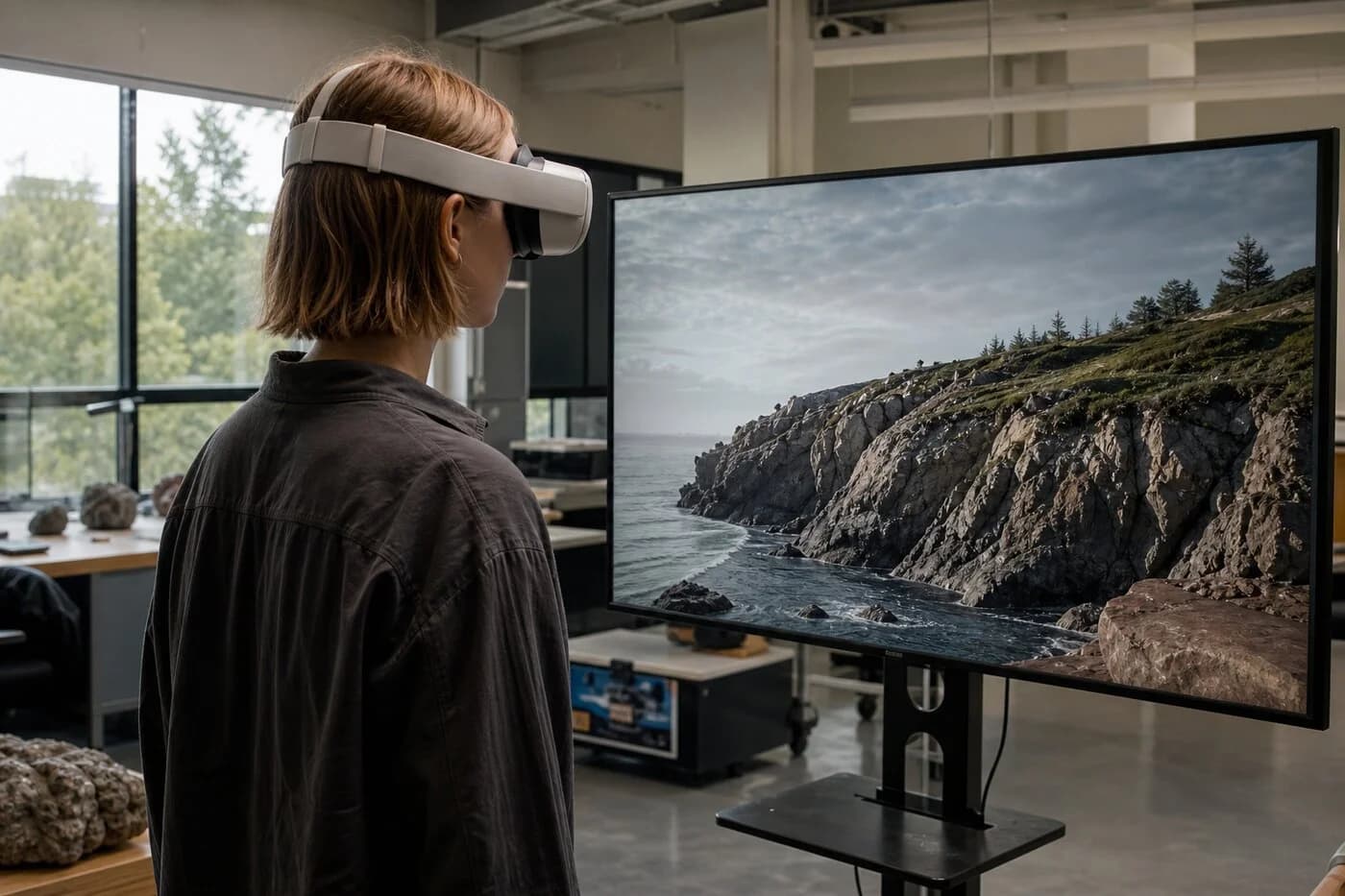
When World Labs opened Marble to the public in November 2025, the announcement read like a research milestone. Fourteen months later it looks more like the starting gun for a product category. Marble is the first commercial "world model" — an AI system whose output is not text, an image, or a video clip, but a persistent, navigable 3D environment you can walk through, edit, and export.
This piece explains what Marble actually does, what it costs the industry's investors to believe in it, and why the "world model" label — which we previously unpacked in our explainer on Yann LeCun's world-model thesis — now describes two very different bets.
What Marble is
Marble is built by World Labs, the San Francisco startup founded in 2024 by Stanford professor Fei-Fei Li, best known for creating ImageNet. It accepts a text prompt, a single photograph, a short video, a panorama, or a rough 3D layout, and generates a full three-dimensional scene: geometry, materials, and lighting that stay consistent as you move a camera through them.
The details matter, because they separate Marble from the video generators it superficially resembles:
- Persistence. A video model re-hallucinates every frame; walk backwards and the room may have changed. Marble generates the world once. Objects stay where they were.
- Editability. Scenes can be expanded region by region and modified after generation, rather than re-rolled from scratch.
- Export. Worlds leave the platform as Gaussian splats, triangle meshes, or rendered video, which is what makes the output usable in Unity, Unreal, or a web viewer rather than trapped in a demo, as the 3D-graphics publication Radiance Fields documented at launch.
Marble launched with a freemium tier and paid plans — a pricing page, not a waitlist. That sounds mundane, and that is the point. Marble is the first world model priced and packaged like a product rather than a research demo.
The money: a category got funded in four months
The clearest evidence that world models graduated from thesis to category is the funding record. We summed the disclosed rounds reported for the four best-funded world-model startups — World Labs, Yann LeCun's AMI Labs, Odyssey, and Decart — from their emergence through mid-2026.

| Company | Founder story | Disclosed funding | Latest round |
|---|---|---|---|
| World Labs | Fei-Fei Li (Stanford, ImageNet) | $1.23B | $1B, Feb 2026 |
| AMI Labs | Yann LeCun, after leaving Meta | $1.03B | seed, 2026 |
| Odyssey | Oliver Cameron (ex-Cruise) | ~$337M | $310M Series B, Jun 2026 |
| Decart | Dean Leitersdorf | ~$453M | $300M, May 2026 |
The number worth lifting from that table: the four best-funded world-model startups have disclosed roughly $2.9 billion in venture funding, and about $2.6 billion of it — nearly 90 percent — closed in the four months between February and June 2026. (Method: sum of rounds disclosed in company announcements and reported by Crunchbase News and The AI Insider; undisclosed rounds excluded.)
World Labs' February round alone brought in $1 billion at a reported $5.4 billion valuation, with NVIDIA, AMD, and Autodesk — which committed $200 million — among the backers. When the three companies that sell the chips and the CAD software of the 3D industry all buy into the same startup, they are not diversifying; they are hedging the same thesis from three directions.
Two meanings of "world model," one label
The funding wave hides a real fork in what these companies build. World Labs and Odyssey generate worlds you can see: explorable environments for games, film previsualization, virtual production, and simulation. LeCun's AMI Labs pursues the older, stricter sense we covered in our LeCun explainer: an internal predictive model that lets an agent anticipate the consequences of its actions — infrastructure for robotics and autonomy, not content.
Both camps benefit from the same tailwinds — spatial data, cheap inference, and the game industry's appetite for faster environment art — but they will be judged by different customers on different timelines. Marble's users will judge it by whether a generated cliff face holds up when a character walks on it. AMI's will judge it by whether a robot falls over less.
An ecosystem is forming at the edges
The second-order signal of a real category is unaffiliated tooling. Marble's exportable formats — splats and meshes rather than proprietary blobs — mean third parties can build viewers, editors, and pipelines around world generation without permission. That is beginning to happen: alongside the research labs, a ring of independent applications is emerging, such as the official Marble3D playground for AI 3D worlds, a subscription tool focused on turning single photos and text prompts into walkable, exportable scenes. (Marble3D is an independent product with no affiliation to World Labs.) The pattern echoes the early Stable Diffusion era, when the model mattered less than the ecosystem of front ends that made it usable.
The open question for that ecosystem is the same one that decided the image-generation race: whether the platforms keep their formats open once the category matures, or pull the drawbridge up behind them.
What to watch
Three things will tell us whether world models are a durable category or 2026's most expensive demo reel:
- Engine integration. The day generated worlds import into Unreal with working collision as a first-class workflow, environment art budgets change permanently.
- The second product. Every funded lab except World Labs is still pre-product. Odyssey's $310 million Series B priced a research preview at $1.45 billion; someone has to ship.
- Whether persistence scales. Today's worlds are room-to-block sized. The demos that matter next are district-sized worlds that stay consistent for hours of exploration.
Fei-Fei Li spent a decade proving that seeing was a data problem. Her second act argues that space is one too — and for the first time, the argument comes with a checkout page.