DOJ Says AI Training Is Fair Use: Inside the OpenAI Brief
The DOJ's statement of interest in NYT v. OpenAI argues LLM training is fair use. We counted every citation in the 20-page brief - what it leans on, what it attacks, and what it never mentions.

Elena Marsh covers science policy for Stanford Tech Review, with a focus on federal research funding, biosecurity oversight, and how Washington governs the labs it pays for.
On September 1, the United States government did something it had never done in the three-year wave of AI copyright litigation: it picked a side. In a 20-page Statement of Interest filed in In re OpenAI, Inc. Copyright Infringement Litigation — the consolidated multidistrict proceeding in the Southern District of New York that includes The New York Times' suit against OpenAI and Microsoft — the Department of Justice told Judge Sidney Stein that training large language models on copyrighted works is fair use, and that ruling otherwise "would be problematic — and legally incorrect."
The filing, made under 28 U.S.C. § 517 (which lets the DOJ "attend to the interests of the United States" in any pending federal case, without asking the court's leave), is signed by Associate Attorney General Stanley E. Woodward, Jr., Assistant Attorney General Brett Shumate, and Senior Counsel Michael Weisbuch. It appears to be the first time the federal government has formally weighed in on the merits of an AI training fair-use dispute, a question pending in dozens of cases against OpenAI, Meta, Anthropic, Stability, Suno, Udio, and others.
The news broke widely on September 2, and spread on X in characteristically compressed form:
SITUATION DETECTED: The US government has sided with OpenAI against the New York Times. The DoJ says training an LLM on copyrighted works does not violate copyright law, and that treating it as infringement would hurt US science, prosperity, and national security.
— MTS (@MTSlive) September 2, 2026
What the brief actually argues
The government's core move is doctrinal, not rhetorical. It walks the four statutory fair-use factors and rests nearly everything on two of them.
On the first factor — the purpose and character of the use — the brief calls LLM training "extraordinarily transformative": the copies are made not to republish articles but to convert text into numerical relationships that let a model "learn linguistic patterns and make predictions." It borrows the strongest language available from the two 2025 district-court decisions that went the industry's way, quoting Bartz v. Anthropic ("transformative — spectacularly so") and Kadrey v. Meta ("highly transformative").
On the fourth factor — market harm — the DOJ argues the legally relevant question is not whether AI causes "some loss of sales" for publishers but whether the training use creates "significant substitutive competition" for the copyrighted works themselves, a standard it draws from the Second Circuit's Authors Guild v. Google decision. Since ChatGPT does not give the public access to the Times articles it trained on, the brief contends, the substitution the copyright statute cares about never happens.
Around that doctrinal core sit the policy arguments that made the headlines: quoting a Government Accountability Office report on AI's military uses, the brief warns that "rules of law that make it significantly more difficult to develop a robust AI industry in the United States therefore threaten national security and give a competitive advantage to foreign adversaries who are not so encumbered." It also argues, strikingly, that a licensing requirement would hurt competition — only the largest technology companies could pay, and the fees would function "primarily as large subsidies for old mainstream media companies."
Read the citations, not the headlines
To see what the brief is really built from, we counted every short-form case-name mention in the text of the filing. The profile is revealing.
| Authority | Court / year | Mentions | How it's used |
|---|---|---|---|
| Authors Guild v. Google | 2d Cir. 2015 | 14 | Backbone: "substitutive competition" standard |
| Campbell v. Acuff-Rose | S. Ct. 1994 | 13 | Transformativeness framework |
| Google v. Oracle | S. Ct. 2021 | 10 | Copying as a step toward new tools |
| Kadrey v. Meta | N.D. Cal. 2025 | 9 | Attacked: "market dilution" dicta |
| Harper & Row v. Nation | S. Ct. 1985 | 5 | Market-impairment language |
| Bartz v. Anthropic | N.D. Cal. 2025 | 4 | Quoted in support |
| Feist v. Rural | S. Ct. 1991 | 3 | Facts are unprotected |
| Warhol v. Goldsmith | S. Ct. 2023 | 1 | Mentioned once |
| Sony v. Universal | S. Ct. 1984 | 1 | Mentioned once |
| Thomson Reuters v. Ross | D. Del. 2025 | 0 | Never mentioned |
Method: short-form case-name counts over the text extracted from the court PDF of Dkt. 316; Google v. Oracle counted by its 593 U.S. reporter citation to avoid conflation with Authors Guild v. Google.

Two things stand out. First, the brief is built on Second Circuit home turf: Authors Guild v. Google — binding precedent in Judge Stein's courtroom in a way no California district-court opinion is — is its single most-cited authority. That is a litigation strategy, not just a survey of the law.
Second, the omissions do real work. The 20-page brief mentions Authors Guild v. Google 14 times and Thomson Reuters v. Ross Intelligence — the February 2025 Delaware decision that remains the only US ruling to reject fair use for AI training — zero times. And where Kadrey v. Meta actually favored the industry on the bottom line (Meta won summary judgment), the DOJ engages it nine times almost entirely to demolish the part publishers like: Judge Vince Chhabria's suggestion that AI-generated works could "dilute" the market for human-written ones. The brief calls that theory "contrary dicta" that "misapplies copyright principles to LLM training," adopted "without the benefit of briefing." In its citation behavior, the filing reads less like a neutral advisory to the court and more like a merits brief for one side, built almost entirely on the precedents that bind the judge who will rule.
The pushback
The Times was blunt. The administration is "siding with a handful of trillion-dollar AI companies at the expense of the countless American creators whose work they stole," a spokesperson said in a statement reported by The Hollywood Reporter, adding that "AI companies simply need to pay fairly for the content that makes their products possible, as copyright law requires."
The replies under the viral post converged on two skeptical theories worth taking seriously. One camp argued the ruling logic will be enforced asymmetrically — as one widely liked reply put it, "You, peasant, will be charged with 'theft' of ideas because you are not in the Big Club" — a concern the brief partially anticipates by taking no position on output-side infringement, which remains fully litigable. A second camp read the filing as purely geopolitical ("China doesn't care about copyright law either"). The text only half supports that: the national-security section is real but short, and the brief's center of gravity is conventional fair-use doctrine. Notably, the government stops short of the maximalist position in one respect: footnote 13 explicitly takes "no position on whether a licensing regime would be financially or logistically feasible," and the brief blesses the voluntary licensing deals publishers have already signed for real-time and paywalled access.
What happens next
A statement of interest is advocacy, not authority — Judge Stein can ignore it. But it lands at a consequential moment: the docket shows the Times' operative complaint was amended just eleven days before the government filed, and Anthropic's $1.5 billion settlement in Bartz — driven by its downloading of pirated libraries rather than by training itself, as TechCrunch notes — has already shown how expensive the acquisition-side questions can be even when training wins. The government has now told every court hearing these cases where it stands. Whether the first Article III judge to reach the question in New York agrees is the decision the entire industry is waiting for.
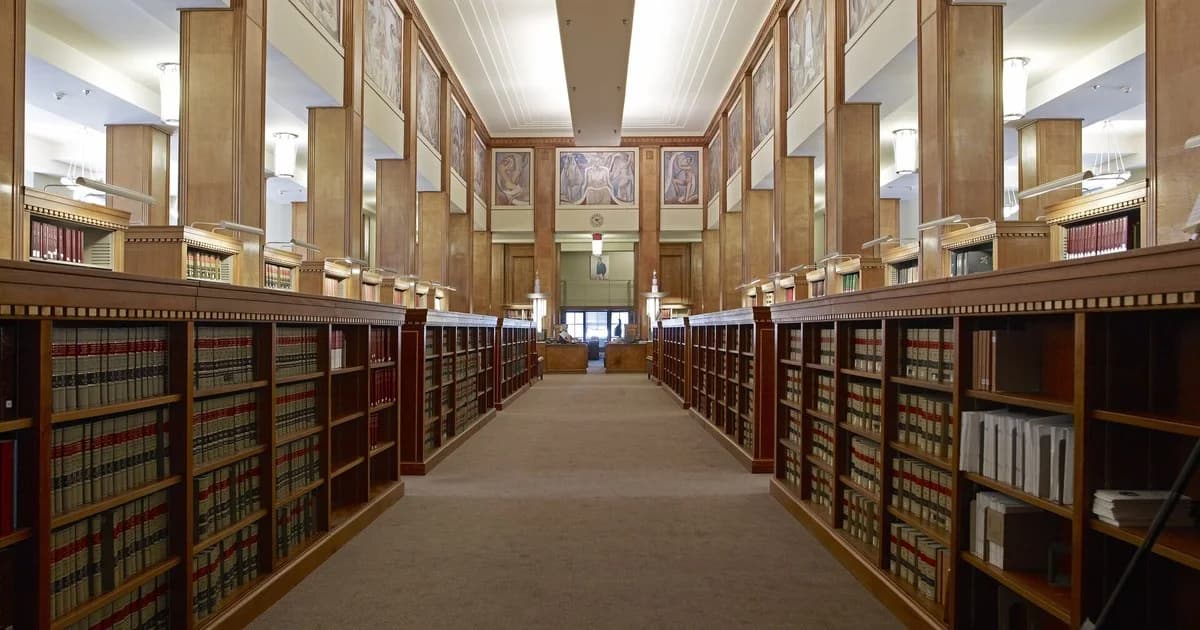
Cover image: the main library of the Robert F. Kennedy Department of Justice Building, Washington, D.C. Photograph by Carol M. Highsmith, Library of Congress collection (public domain).