The Floor Nobody Looks At Before Closing the Pool
Whatever sits on the pool floor in October is still there in April, only worse. The case for a cordless handheld vacuum pass before the cover goes on.

Data journalist covering markets, platforms, and the economics of rating systems.
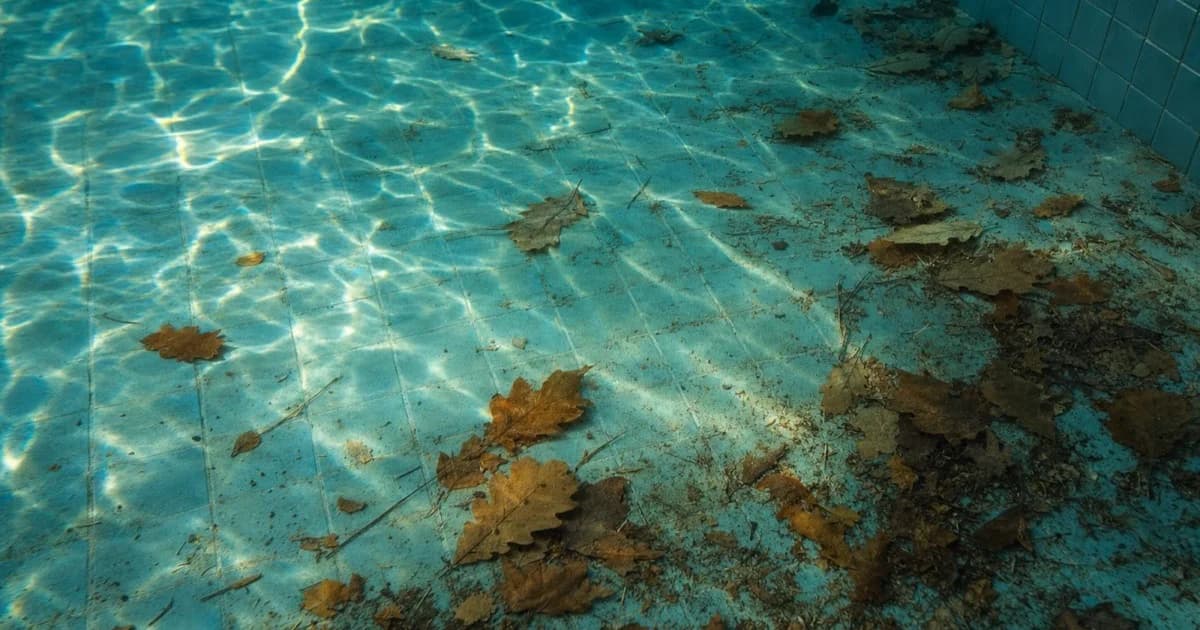
What Gets Sealed Under the Cover
The pool-closing checklist is one of the most widely circulated documents in home maintenance, and it is remarkably consistent. Balance the water. Lower the level. Blow out the lines. Add the closing chemicals. Fit the cover.
Almost every version of it treats "clean the pool" as a single line, and almost every pool owner interprets that line as skimming the surface and brushing the walls. The floor gets a look, and if the water is clear, it gets a pass.
That pass is expensive, because whatever is on the floor in October is going to be there in April, in a warm, sealed, chemically declining environment, with no sunlight and no circulation.
Six Months Is a Long Time for Organic Matter
A layer of leaf litter under a winter cover does three things.
It stains. Tannins leach continuously from decomposing plant matter, and on plaster, pebble and light vinyl surfaces the result is the brown shadowing that greets people at spring opening — often in the exact shape of the leaves that made it.
It consumes sanitizer. Closing chemicals are dosed on the assumption of a reasonably clean vessel. Organic load eats through that budget early, which is why some pools open green despite having been closed correctly.
And it compacts. Wet debris that sits undisturbed for six months does not vacuum the way fresh debris does. What would have been a twenty-minute job in October becomes a genuine project in April, sometimes with a service call attached.
The Case for a Handheld, Specifically
Vacuuming a pool traditionally means a hose, a vacuum head, a pole, and either a booster pump or a suction line — a setup that takes longer to assemble than most people will tolerate for a single pass.
The Betta Jet Sweep removes that setup entirely. It is a cordless handheld pool vacuum: a rechargeable unit that attaches to a standard telescoping pole and drives itself across the floor on four 360-degree wheels, with no hoses, no pump and nothing to prime.

For a closing pass, that matters more than raw power, because the decisive factor is whether the job actually gets done in the narrow window between "the leaves have finished falling" and "it is too cold to stand out here." A tool that is ready in ninety seconds gets used. A tool that requires an assembly is postponed until it is no longer worth doing.
Runtime Against the Size of the Job
The Jet Sweep's rechargeable lithium-ion battery delivers up to 75 minutes of runtime per charge, with a built-in battery indicator so the level is visible before starting rather than discovered halfway along the deep end.
Seventy-five minutes is a useful number for a closing pass on a typical residential pool. It is long enough for a full floor sweep plus a second run over the deep-end drift where debris collects, which is where most of the winter's problems originate.
Two Bags, and Why the Fine One Matters in Autumn
The Jet Sweep ships with two filter bags, and the pairing is more relevant at closing than at any other time of year:
- Standard 250 micron — for everyday debris collection: leaves, twigs, the visible material.
- Intensive 75 micron — designed to capture finer particles for improved water clarity.
The autumn sequence is straightforward. Run the standard bag first and take out the bulk. Then switch to the 75-micron bag and go again for the fine silt, pollen residue and broken-down leaf fragments that a coarse bag passes straight through — the material that is invisible in clear water and entirely responsible for how a pool looks in April.
The bags use a quick-release, tool-free connection, so the changeover is a matter of seconds rather than a reason to skip the second pass.

The Protections That Matter for a Once-a-Season Tool
Two things on the Jet Sweep exist specifically for equipment that gets used intermittently and stored between uses.
It shuts off automatically when lifted out of the water, which prevents the motor running dry during the constant in-and-out of a closing pass. And it stops automatically if debris clogs the impeller, with a red indicator light — a real consideration in October, when the material going into the machine is larger and stringier than anything it handled in July.
One practical note: a pool telescoping pole is not included. The unit fits standard telepoles, so most owners already have one leaning against the fence, but it is worth confirming before the day of the job.
Timing the Pass, Which Is Where Most People Get It Wrong

The instinct is to do the floor clean early — get it out of the way on a warm weekend in late September, then close whenever the weather turns.
That sequence wastes the work, because the heaviest leaf drop usually arrives after it. The pool spends three weeks collecting a fresh layer, and the cover goes on over material that was never touched.
The better sequence puts the floor pass as late in the process as the weather allows: after the trees near the pool have finished, immediately before the cover. If a surface skimmer has been running through the drop, most of what would otherwise be on the floor was intercepted on the way down, and the final pass is genuinely a final pass rather than a first attempt.
Where the schedule cannot wait — a hard freeze arriving early, a service appointment that cannot move — two shorter passes beat one perfectly timed one that never happens.
Surface Type Changes the Stakes
The cost of skipping the floor is not the same on every pool.
On plaster and pebble finishes, tannin staining bonds into a porous surface and often needs acid washing or a lengthy chemical treatment to remove — a spring expense that dwarfs the twenty minutes it would have taken to prevent.
On vinyl liners, prolonged contact with decomposing organic matter can leave discoloration that does not lift at all, because the staining is in the printed surface rather than on it.
On fiberglass, the staining is generally the most forgiving of the three, though a heavy organic load still consumes closing chemicals at a rate the dose was not designed for.
In every case the arithmetic runs the same direction. The material is easiest to remove on the day it lands, harder in October, and a project in April.
Where This Sits Alongside Automated Skimming
A robotic surface skimmer and a handheld floor vacuum divide the pool the way the mess divides. Skimmers work continuously on top of the water, catching material before it sinks. A handheld vacuum handles what already reached the bottom, on demand.
Neither replaces the other, and the split is at its clearest in autumn. Continuous surface capture reduces how much reaches the floor across the whole leaf drop. The floor pass at the end deals with what got through.
The Argument in One Line
Everything on the pool floor in October is still going to be there in April, only worse. A single deliberate floor pass before the cover goes on is the cheapest maintenance decision available in the entire pool calendar, and the only reason it gets skipped is that the traditional way of doing it takes too long to bother with.