Which AI Model Builds the Best Slides? Inside a 2026 Benchmark
A 2026 benchmark of 128 AI-generated slide decks finds GPT-5.6 and Claude Opus 4.8 tie for the best slides, while agentic self-refinement adds cost without measurable quality.

Marcus Feldman writes about hardware security and the consumer-electronics supply chain.

Every enterprise software team shipping an "AI presentation" feature in 2026 faces the same architectural fork: lean on a single strong model, or wrap it in an agentic loop that drafts, critiques, and rewrites its own work. The second option looks obviously better. A new benchmark suggests it usually isn't.
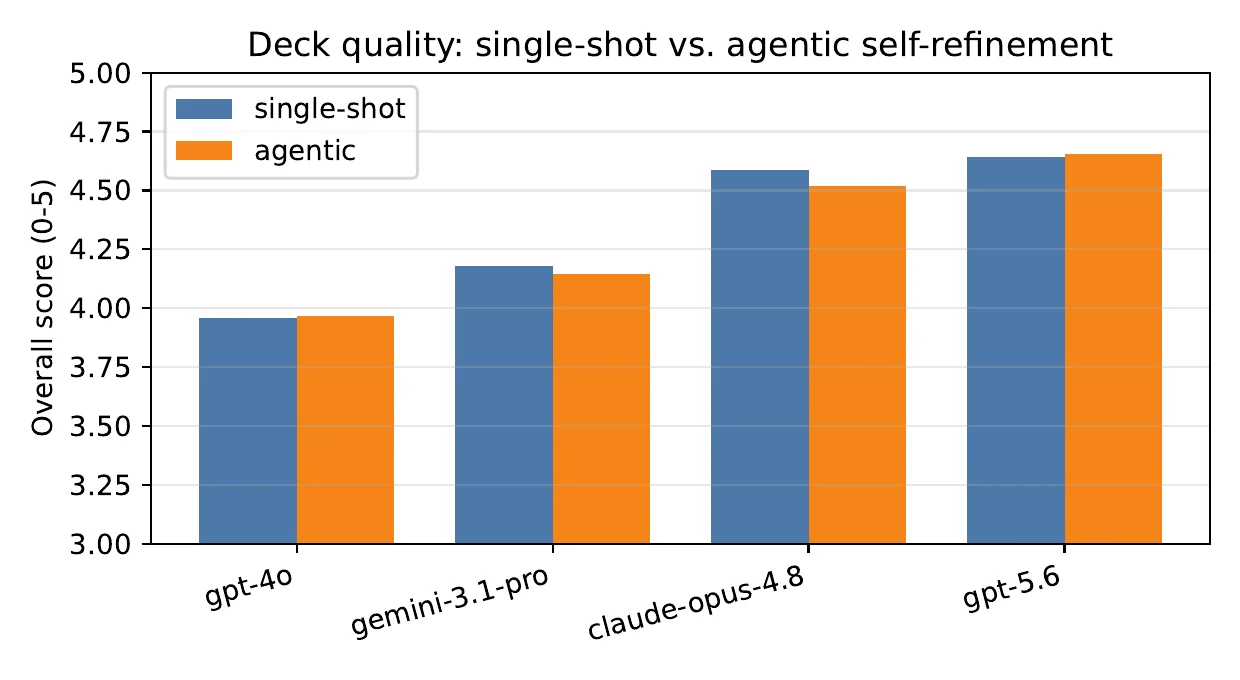
The study evaluated 128 AI-generated slide decks across four models and two generation strategies on sixteen distinct topics, from business analysis to science explainers to operations playbooks. Each deck was an eight-slide presentation scored zero to five on content, structure, density, design fit, and coverage by a three-judge ensemble of frontier models, with leave-one-out scoring so no model graded its own family.
Two Models Tie at the Top
On single-shot generation, the ranking was tight at the top and clear at the bottom:
| Model | Slide quality (0–5) |
|---|---|
| GPT-5.6 | 4.64 |
| Claude Opus 4.8 | 4.59 |
| Gemini 3.1 Pro | 4.18 |
| GPT-4o | 3.96 |
GPT-5.6 and Claude Opus 4.8 are a statistical dead heat (the gap is not significant, p = 0.44). Both decisively outclass the older GPT-4o, which lagged mainly on content depth and topic coverage. For teams still defaulting to a previous-generation model, that gap, roughly 0.6 points, is the single largest quality lever in the entire study, and it comes from the base model alone.
The Agentic Loop That Wasn't
The headline result is what didn't happen. Letting a model critique and rewrite its own deck produced no statistically significant quality gain for any of the four models (paired t-tests, all p > 0.17). The lifts ranged from −0.07 to +0.01, every one inside its own margin of error.
The loop was not free, either. For the OpenAI models it cost up to five times more and ran up to three and a half times slower, and it occasionally broke the requested slide count when a revision pass reopened a constraint the first draft had already satisfied. In other words: on capable models, the first draft is already near the quality ceiling, and asking the model to "improve" it mostly reshuffles wording, sometimes for the worse.
This aligns with a broader turn in the self-correction literature, which increasingly finds that intrinsic self-critique helps far less than assumed once a model is already strong. The full methodology, per-dimension scores, and statistical detail are laid out in this 2026 benchmark of the best AI model for slides, which also releases its harness and raw scores for replication.
What It Means for Builders
For anyone choosing or building an AI presentation tool, the takeaway is unusually clean:
- Prioritize the base model. A current frontier model (a GPT-5-class model or Claude Opus 4.8) buys more quality than any clever multi-step pipeline.
- Skip the self-critique agent. A well-prompted single pass beats a same-model refinement loop at a fraction of the cost and latency.
- Spend engineering effort on prompting and structure, not on an orchestration layer that the data says does not pay off.
It is a pattern worth naming: for this task, capability beats choreography. Products already built this way reflect it, ChatSlide generates decks in a single strong pass from a GPT-5-class model rather than an expensive self-critique loop.
The Caveats
This is a benchmark, not gospel. Scores come from AI judges rather than a large human panel, though the three-judge ensemble and leave-one-out design reduce self-preference bias. It covers sixteen tasks, one deck format, and one refinement design, a solid signal rather than the last word. Notably, an earlier six-task pilot had suggested self-refinement helps weaker models; that effect vanished once the task set grew and the judging tightened, a useful reminder that small AI benchmarks mislead.
For now, the evidence points one way. In the race to make presentations with AI, the model you pick matters far more than the agent you wrap around it.